by admin | May 28, 2017 | Authenticity, character, crime fiction, Cumbria, fact-based fiction, Fallout, plotting, readers, Unbound, Uncategorized, Windscale fire
Three years ago I was in the final stages of writing my third novel ‘Fallout‘, which had as its backdrop the nuclear reactor accident at Windscale in Cumbria in October 1957.
Deciding on that context for a story about finding love in later life was a gamble. For a start, the background might end up being much more interesting than the main story line. And dealing with a real event was always going to be tricky. It’s a touchy subject here in Cumbria even after sixty years: the final report on the incident used a phrase about ‘local errors of judgement’ that still rankles. (Actually the phrase was inserted into the report by the Macmillan government as a way of explaining the incident to the Americans without blaming the government’s own rushed reactor building programme.) And of course, because it was a ‘real’ incident within living memory it was essential for me – a local ‘offcomer’ – to get the facts right.
The inside story of the reactor fire was a complicated technical issue. How was I going to help the non-scientific reader to understand what was really going on, and why the key the decisions were made? The plan was to place a character on the inside of the Windscale whose job was to ask questions about the operation of the reactor. This character would act as the reader’s ‘friend’, gathering information in an intelligible way. in ‘Fallout’ this character was Lawrence Finer, seconded to Windscale from Harwell, the nuclear research facility near Oxford.
In my next book ‘Burning Secret’ I face the same issue – explaining farming to a non-farming readership, and then clarifying the complications of a catastrophic infection that decimated our farm animals in 2001. I need a character that acts as the ‘guide’ to a specialist subject for a non-specialist audience. Talking to a local dairy farmer last week it occurred to me how to handle this. 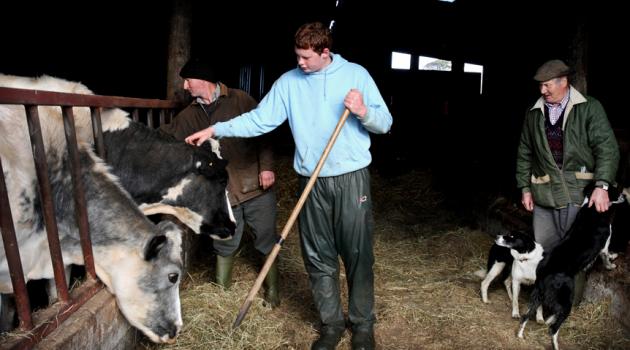 Large dairy farms often employ people to help with milking and the care of the herd, but during the outbreak restrictions were introduced that made it impossible for dairy farm workers to work normally, going home after work and coming back the next day. This particular farm asked a family friend from Liverpool to come and stay on the farm for the duration to help them, and the young man had no experience of farming life. He reacted to the everyday routines of the farm as you or I might, noticing things that the farmers took for granted, asking naive questions, making mistakes through lack of experience. In literary terms, this character’s function is somewhere between the Greek chorus and the gravediggers in Hamlet, and more emotionally detached than the farmers themselves as the outbreak spread ever closer. In a crime story, as this will be, the ‘stranger’ can also be a useful source of tension and mystery. Let’s see how it all turns out.
by admin | May 18, 2017 | crime fiction, Cumbria, fact-based fiction, historical fiction, Lake District, Publishing, readers, Uncategorized
Having done my deal with Unbound.com to publish my next book ‘Burning Secret‘ – a crime story set during the Cumbria foot and mouth disease crisis in 2001- there’s now a link unbound.com/books/burning-secret to the page where the project is explained, illustrated and presented in a video. Alongside all this information is a list of possible pledges that interested people can make, ranging from the simplest – the ebook of ‘Burning Secret’ – to the more elaborate, a customised tour of West Cumbria with the author (me) to find the key sites and settings of my novels. The project needs hundreds of these pledges, small and larger, to reach the target fund and get the book published.
 It’s called ‘crowd-funding’ – a term only vaguely familiar to me before I started down this road. I wonder how it really works: do people actually pay money up front for something that may not appear for months, and if so what motivates them to do so?
Apparently Unbound are interested in this too, and the research they’ve commissioned seems to be saying that people like to feel part of the project: their willingness to join this ‘crowd’ is about being a member of a shared enterprise, an insider, a patron not just a reader.
I have to admit that as a pre-internet adult, growing up before ‘social media’ were even dreamt of, all this has been something of a mystery to me. More importantly, I guess it must be something of a mystery to many of my readers too. Book buyers of my generation expect the book to be finished and ready to buy before we pay our money for it. We might buy online, but this ‘pre-order and be part of the supporters’ club‘ notion may feel odd.
If that’s true, if the baby-boomer generation doesn’t ‘get’ crowd-funding, then I need to think again about finding those pledges. ‘You have to nag people,’ is the advice I get about this, but nagging goes against the grain. I feel I have a relationship with many of the people I’m asking for pledges, and that this relationship could be jeopardised by pushing them to behave in a way that feels unfamiliar. ‘Do this for me, please’ sounds whiney and manipulative.
Clearly I have some thinking to do, or perhaps I’m just reacting too quickly and the crowd-funding process just takes longer than I expected. In the meantime the necessary link https://unbound.com/books/burning-secret is being widely shared, but the numbers of visits to the link far outweigh the number of actual pledges. Is this what happens?
Here’s the question, does the crowd ‘pond’ from which pledges are drawn need to be wide and shallow, or small and deep? Maybe I should focus on getting a smaller number of high-level ‘donations’ and sponsorship, rather than chasing individual pre-orders. Any suggestions?
by admin | May 12, 2017 | crime fiction, crowd-funding, Cumbria, fact-based fiction, genre, Lake District, landscape, Publishing, readers, selling, Uncategorized, West Cumbria
A fter a flurry of activity the Unbound project to publish my next book went live on Monday. I’ve been busy the past few days emailing the link to dozens of people asking for their support. This is the very classy flyer that gives the basic details but there’s much more on this link.
Yesterday I did a marathon tour of some of the libraries at the other end of Cumbria, where foot and mouth was rampant, and heard more memorable stories from the catastrophic outbreak in 2001. It was the smell that is most vividly remembered: animal carcasses, and the smoke from the pyres. A dystopian landscape.
For the next few weeks I’ll be busy getting the link and the flyer shared as widely as possible, and encouraging people to pledge their support for the project anyway they can. If you can help, please do and I’ll be very grateful. Thanks.
by admin | Mar 19, 2017 | crime fiction, Cruel Tide, Fatal Reckoning, genre, Uncategorized, violence
A year or so ago, it seemed as if the psychological thriller was destined to overtake most other sub-genres of crime fiction. There’ll always be a market for ‘cosy crime’, but the best-seller thrillers were at the other end of the spectrum, featuring graphic violence and sadism, much of which was either directed against or perpetrated by women, and written by women too. Highly improbable twists and turns were the order of the day, and the final climax was required to be sickeningly bloody.
As an aspiring crime fiction writer I was depressed by this trend. I found the books very hard to read, couldn’t contemplate writing that way, and was therefore apparently condemned to be ‘unfashionable’. Was this just squeamishness or cowardice on my part? No, it was a choice, and I chose not to go that way. My two crime books ‘Cruel Tide’ and ‘Fatal Reckoning’ were strong on setting and character, but seemed to fall between two stools – harmless ‘who-dunnits’ on the one hand, and miserable misogyny on the other. I was heartened when Fahrenheit Press agreed to p ublish my crime novels both as ebooks and POD, but I was less interested in writing further crime fiction if I couldn’t resolve my dilemma about the style.
Discussing my future writing ideas recently with a well-connected London-based ‘commissioning editor’ I was surprised and pleased when she offered the view that the trend for violent thrillers was waning, nudged away by a renewed interest in rural rather than metropolitan settings and a gentler view of life, which would in turn produce a different style of crime fiction.
And in recent reports from the London Book Fair, similar views have emerged there too. Maybe it is felt, as I have felt myself, that excessive violence verges on the pornographic and has reached its limits as a popular genre. If this is true, I for one am delighted.
by admin | Mar 4, 2017 | crime fiction, marketing, Publishing, reviews, royalties, self-publishing, Uncategorized

I’m sure I’ve blogged about finding an agent before: I certainly think about it ‘ad nauseam’, but until this past week I’ve done nothing about it since about 2012. Aversion, avoidance – for whatever reason I’ve put it off, until a necessary change in my route to publication has forced me to take a next step.
The change is necessitated by the retirement of the publishing partners, editor and book designer, with whom I’ve worked since I decided to self-publish several years ago. If I want to continue writing, then I need to do something to fill that gap. There are three possible options:
- find an editor and a book designer, preferably closer than London, establish a relationship and work with them in the same way as before. I take their advice, and pay them for it, and keep overall control of the process and of the income generated by the books. The costs are upfront and considerable, but I’m used to that, and it works, so long as there’s a reasonable rate of sales;
- approach a publisher direct. It would have to be one of the few who will accept ‘unagented’ projects, and ideally they would take on my backlist too, reprints, storage, orders, distribution, and so on, leaving me more time to focus on the writing. You can find independent publishers like this, but keep an eye on the small print, and on the royalties – how much and how often. Ebook only publishers are more generous, as they should be given lower costs, but if you want to produce a paperback in larger numbers, not just Print on Demand, the number of potential publishers goes down. Some are focussed only on crime fiction, which might not suit my future writing plans;
- Find an agent. This is the default choice these days if you want to get ‘traditionally’ published. The majority of publishers will deal only with agents, who act as a ‘first filter’ and protect the publisher from being overwhelmed with stuff they don’t want and can’t sell. Fair enough, but it still feels like you’re dealing with the doctor’s receptionist, who may or may not have the skills to recognise symptons and do proper ‘triage’.
For the time being, I’m keeping my options open by pursuing all three of these routes simultaneously. Down comes the ‘Writers’ and Artists’ Yearbook’ from the shelf and I start combing through, doing everything I’ve advised my aspiring writers to do in my workshops and have been so reluctant to do myself.
The list I gathered of possible agents was quite long, and of course almost all of them were in London, which always pisses me off. (I had to explain to an agent in London once that ‘Cumbria’ was actually an English county, not somewhere in Italy where Islington goes on holiday.) Because I’m interested in getting my backlist re-published rather than touting a half-finished draft, it’s a different ‘submission’ process, more factual and less aspirational, but I still feel like the ‘supplicant’ rather than a prospective partner, and I still don’t like it. I’m a mature woman with a successful career, five popular novels and an enthusiastic (local) following. I fear I’m not the kind of client many agents would want to work with – too stroppy, too old, and too far from the literary action, and part of me knows that. But here I am, deserving of attention, but I fear I will get get very little. One good response in the few days since my first exploratory emails went out, one mildly curious, and three rejections so far, worded almost exactly the same way as the rejections I received last time around.
Early days yet. I understand applications to agents take a long time to process: they have to be weighed against each other, as only a small number of new clients can be handled at once. Waiting is always a drag: patience is not one of my strengths. But I am resigned to the delay. Maybe my current circumstances are different enough from five years ago to make the outcome different too.
One independent publisher has reacted fast and positively, but they want only crime books and I have yet to see what their contractual terms might be. If the potential sales are high enough then acceptance of a low royalty might work out. But what if they’re not? Publishers talk about the quality of their marketing, but how can you substantiate that? Amazon ebooks sales figures can be manipulated, and I want my books on shelves, not just in the cloud.
Reading this, I can see why I’m an unattractive proposition. I ask questions and have clear expectations, and five books self-published in five years gives me a bit of clout. Maybe I have the answer to my question, but I keep on asking it. Apart from the first step of getting published, I want some of the extras that could come through ‘traditional’ publishing – access to reviews, to the major book-chain shelves, to radio or TV, or audio book production expertise. I write good stories that people enjoy, and I want more people to be able to find them. So I wait for the responses to my search for professional help, but I’m not holding my breath.
by admin | Feb 28, 2017 | crime fiction, Cruel Tide, Fatal Reckoning, historic child abuse enquiry, historical fiction, Morecambe Bay, research, Uncategorized
Whenever I talk to local audiences about the two crime books, Cruel Tide and Fatal Reckoning, I explain that the institutions where the abuse of children occurred were not on the Morecambe Bay coast of Furness as is portrayed in the stories, but elsewhere. I also explain why I ‘anonymised’ the communities, to hide their identity. One of the challenges of writing local fiction is that communities don’t relish being named as places where bad people do – or did – bad things.
Just this week I’ve been reminded of another challenge: having done so much research about your potential subject matter, how much can you actually use without incurring the critical response – ‘Excuse me, your research is showing.’ The trick is to use only a fraction of the information you have, just enough detail to conjure up the authentic feel of setting or story without boring or overwhelming the reader who wants the plot to move on.
Here’s a case in point. While I was investigating institutional child abuse and how it was covered up in the 1960s and 1970s, I discovered the extent of ‘child emigration’ to the old ‘colonies’ during the post-war years, and the horrific experiences of some of those children. In particular I read about a boy’s home in Western Australia called Bindoon, which was run by Catholic priests. Hundreds of boys were sent there and subject to appalling physical and sexual abuse, which was either not known about by both English and Australian authorities or was discounted or covered up to save them the problem of sorting it out.
In my novel Cruel Tide, a mysterious character appears who seems to have spent much of his life in Australia, and has returned to search for his younger brother who has also ended up in care. Without spoiling the plot, let’s say he meets a tragic end. In all but the final draft of the novel, as he lies dying he says one word ‘Bindoon.’ It’s a strange word, and I really wanted readers to wonder about it, and follow later attempts to find out what it meant, or even check it out themselves. My editor wasn’t sure. The word was new to her too. ‘Is it too distracting?’ she asked. ‘Is it necessary?’ In a sense, it was distracting and even unnecessary, but I held out for its inclusion until the very last draft, when I folded, succumbed to advice and took it out. If you want to see the context, read Chapter 21 of Cruel Tide. Better still, read the whole book.
This week, there it is in the top news stories: ‘Bindoon’, as the enquiry into historic child abuse begins its work in London, with a focus on the abuse suffered by the child migrants in Australia. How I wish I’d left the reference in place, as a testament to those nameless boys and what they went through.
Recent Comments