by admin | Sep 15, 2017 | crime fiction, self-publishing, selling, success, Uncategorized, West Cumbria
Last Thursday evening I had a great opportunity to see a very successful writer up close and hear the details of her career.  Ann Cleeves was visiting Cockermouth in West Cumbria, not far from from where I live, and I was asked to ‘interview’ her live in front of a sold-out audience. So I got to decide some of the questions that I was most interested in. This woman has written an astonishing 30 books in 30 years: ‘How did it all start?’ I asked her. ‘Well,’ she said with a smile, ‘for the first twenty of those thirty years I made only enough money to pay for a week’s caravan holiday in Dorset.’
It was only after the first of Ann’s ‘Vera Stanhope’ series was bought for TV that her career really took off. And how did that happen? A classic serendipity: in a charity shop in London the book – ‘The Crow Trap’ – was picked up by a person who worked in TV production, as something to read on holiday. The company she worked for was looking for something to replace ‘Frost’ on ITV, Ann’s book fitted the bill exactly, and the rest, as they say, is history. The ‘Vera’ TV shows now sell to over 120 territories worldwide, and the Shetland series has also been successfully adapted for TV. 
Ann’s books are good, no question, but much of the extraordinary success she has enjoyed in the past decade stems from that chance purchase in a charity shop. As she joked herself last night, crime writers are busy dropping copies of their books into charity shops all over London, hoping to become the next TV sensation and enjoy everything that follows.
Knowing how arbitrary these matters can be, how does it make a struggling writer like me feel? Very happy for Ann, naturally. Some regret also that I left it so late to try my hand at fiction. When you first publish at 65, waiting twenty years to hit the big time is tempting fate. But the overriding feeling, if commercial success is indeed so much matter of luck, is that the only thing you as the writer can really control is the quality of the work you do. Even if your books don’t reach a mass audience, you aspire to make them truly worthwhile – well-researched, well-written, memorable, and a credit to your effort and skills. That’s a legacy to be proud of, whether you sell a thousand or a million.
by admin | Sep 10, 2017 | 'unreliable narrator', character, crime fiction, planning, point of view, Uncategorized
The opening chapters of any novel are crucial. You have to give readers some information to locate the story and the people, and enough to intrigue them and make them want to read on. There has to be some sense of foreboding, or puzzle, or a hint that things may not be as they appear to be.

That sounds easy enough, but it’s actually a difficult balance to find: a classic ‘Goldilocks’ question, not too little, not too much. If the reader is given absolutely no clue, however subtle, about what might be coming, the story can quickly turn into ‘one shock after another’ with motiveless action and surprise for its own sake. I don’t like that as a reader: it feels manipulative and lazy, and I don’t want to do that as a writer. Too much hinting or heralding doesn’t work either: that feels patronising, as if the reader has to be hit over the head with something to notice it. The ‘Goldilocks’ solution is to offer just the merest mention in passing, so easily missed that the reader finds herself leafing back later, to check whether they actually read it at all, or just imagined it.
The opening chapters of this new book – emerging painfully through the exercise of my slowly mending shoulder ligaments – is a stop and start affair as I struggle to find the right balance. One word, just one word, can make such a difference. As ever, adverbs are to be avoided wherever possible, so the reader is only offered what is done, not how it’s done. The character isn’t thinking about the ‘how’ – why should they, in the privacy of their own space? – so the reader should be allowed only what is seen or heard, unadorned by any authorial intervention.
The other challenge in the opening chapters of this particular story is to present several thousand words from the POV of an adolescent. The reader is to be offered only what the young person sees, hears and experiences. I’m having to remember the mannerisms and reactions of young people I’ve worked with as a teacher over many years, the swings of mood, the partially-informed judgements, the speech patterns. I have a relative of roughly the same age too, but she’s such a different person from the character I’m working with that using her as the example might not be helpful. Much of the ensuing plot hinges around the reactions of this character, and the ways in which new circumstances can provoke change, as well as the rapid changes that always surround early adolescence and puberty.
With all this buzzing in my head, there’s serious frustration in only being able to type for a few minutes at a time. I’m told by everyone that I must be patient, that ligaments and tendons take a long time to heal. I know that, but it’s still galling. I probably need to ration myself: no email, no blogging, until and unless the necessary daily book words targets is reached. Discipline, Ruth. Discipline!
by admin | Sep 1, 2017 | ethical questions, feedback, readers, self-publishing, self-publishing workshops, success, Uncategorized, writing workshops
I spent decades of my professional life working with schools and education systems on how they find out how well they’re doing: what information to gather, how to do so, and how to use the information so that it improves their ‘performance’ rather than just measures it. As the old saying goes, ‘weighing the pig doesn’t make it grow.’
Many of my Twitter contacts are educators, from all around the world, and these same concerns never seem to fade. All of us accept that as educators we should be accountable for the public money we spend and for the futures of our students that we share with their families. The issue has never been ‘accountability’: it’s always been accountability to whom, for what, and what information is pertinent to these purposes.
The key first step is to define what constitutes success in our classrooms, schools and systems. Only after that can we decide what information will relate to and reveal these important outcomes. All sorts of information can be useful, including numerical data, so long as the numbers accurately represent something of agreed value. The problem is that the quick and ‘manageable’ tests commonly used as the most important measure are seriously flawed, capable only of representing a fraction of the outcomes that we all agree to be important in preparing our children for their future lives. These future lives are to be lived in the 21st century, not the 19th.
Of course, our young people need to be literate and numerate, but they also essentially need to be resourceful, flexible, digitally confident, and collaborative if they are to thrive as individuals. If the communities and societies they inhabit are to be successful, our people also need to be aware and respectful of others, thoughtful, optimistic – the list goes on, influenced by one’s view of the world.
Unfortunately, in England, our students and their schools face a barrage of measurement that hardly scratches the surface of the information we really need. Students’ worth can be calibrated on their performance in these inadequate assessments, and – as we have seen this week – those students whose estimated future performance might adversely affect the school’s overall ‘scores’ can be asked to leave. This perversion of true educative values has been going on for years, and this week’s headlines have been no surprise to many of us.
There is much more to say about all this, but for now I want to make a link to what can be defined as a ‘successful’ book, or author. Yes, of course ‘success’ can be defined simply in sales which are gratifyingly easy to count, but even that number doesn’t equate to the number of people who actually read the book, finding it in a library or lent by a friend. Other quantifiable measures might be the number of five-star reviews on Amazon, but you don’t have to look hard to find the flaws there.
Professional reviews? Questionable indicators of quality, in terms of which books are chosen and how they are reviewed, by whom, and under what pressure or obligation from a shared publisher or personal loyalty.
As with education, the starting point for deciding the success of a book is to ask the author to define what they were wanting to achieve, and go from there. When I run my workshops on “Successful self-publishing” that’s where we start. ‘What constitutes success for you?’ I ask, ‘and what it would look like if this were achieved?’
In writing as well as learning, the most useful information is ‘ipsative’, from the Latin ‘ipse’ meaning ‘self’. We are most usefully assessed against our own previous best, not against some external norms, or even against criteria that may not fully reflect our personal aspirations. If you’re a teacher or a writer, what does success look like for you?
by admin | Aug 26, 2017 | accident, slow writing,, character, crime fiction, opening paragraph, plot devices, plotting, point of view, readers, structure, Uncategorized
My temporary living space is looking pretty well organised now (check previous posts to see what this is all about). And my head is getting round the new situation too: instead of fretting about the necessary confinement I’m using the time to tackle something that’s been overshadowed by health issues for a a couple of weeks – starting the first draft of the new book.

The outline is pretty well sorted, apart from the final denouement which I want to leave loose for now. So first thing this morning I split my screen, posted the outline of Chapter 1 on one side and pulled up a blank document on the other headed, ‘Burning Secret Chapter 1’. The title may change, but it’ll do for now.
Immediately at this point the writer faces a choice about ‘point of view’. Whose eyes am I looking through in this scene? Whose head am I inside, and what does this person see, hear, do and feel? What are the implications of this choice, and is it significant for the reader? It’s a chance to clarify who is at the centre of the story, or possibly to catch the reader off-guard. Do you remember the film ‘Psycho’? For the first several minutes of that Hitchcock masterpiece the viewer thinks they’re being told a story about Janet Leigh’s character having an affair. All the action is from her point of view, until in an iconic shocking twist her character is gone and we are jolted into another story. The decision about the first POV the reader encounters is one the writer needs to think carefully about.
For this book I’ve decided that POV should stay the same for the whole of the first chapter. The setting, both time and place, is quite complicated and one POV is probably enough for the reader to manage. Perhaps at the chapter’s end the hook to draw the reader forward could be the introduction of a new POV, as the story begins to unfold. 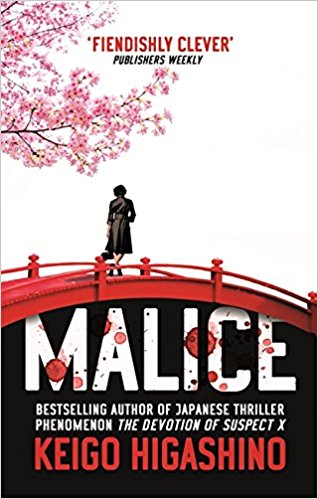
I read an excellent Japanese crime story recently, – ‘Malice’ by Keigo Higashino – at the end of which there was an interview with the author about the techniques he’d used. One of these was to give the reader an early memorable snippet of information about a key character that would be crucial in establishing whether the character was trustworthy or likeable. With that impression established, the reader would interpret the character’s behaviour through that lens. ‘First impressions count’ is the message, and those impressions are manipulated by the author.
So, the choice of character for the first POV, the information the reader is offered, the source of that information and what it signifies, are all Chapter One decisions. However well I’ve planned, much of this subtlety only presents itself when the actual first draft is being written. And that’s what I started on yesterday. I couldn’t write for long because of the sore shoulder, and I’m writing this post early so I can rest for a while before going back to Chapter One later in the morning. Pacing myself like this is useful as it makes me think more about what I’m doing and why, instead of just racing on.
For those of you who are new to this blog, I’m confined to the house having injured myself in a fall, and trying to use this as an opportunity for achievement, not just a source of frustration. It’s Day 2 of a ten day confinement: I hope the good intentions can be sustained. While the rest of country is starting the busiest holiday weekend of the year I shall be quiet in my small space and live inside my head. And if I need distractionthere’s a cricket test match to listen to on the radio. What more could I want?
by admin | Aug 23, 2017 | accident, slow writing,, retirement, thinking, Uncategorized
Things can certainly change pretty fast, especially when you fall down the stairs.
At around 1.45am on August 15th I was bouncing backwards down the steep staircase in my house. By the time I’d stopped moving and was lying in a heap at the bottom I’d torn my right shoulder ligaments and ruptured my left Achilles tendon, plus bruising and friction burns. The past week has been a blur of tests and visits to hospital and now I have a large boot, very like a long ski boot, wrapped tightly round my left calf, ankle and foot, where it will stay for several weeks.

I cannot imagine how someone without health insurance in a less enlightened society would access the expertise and care that has been so quickly been available to me at no cost, through the NHS.
The shoulder is improving, but using the keyboard can be painful and the physio recommends only 30 minutes maximum without a rest. And mobility will be an issue for 6-8 weeks while the big boot remains in place.
Being partially immobilised is – at its most objective – an interesting experience. Every movement has to be considered and planned cognitively, to find the most efficient and painless way of getting from A to B while protecting the damaged bits of your body. The processing as much as the physical constraints slow you down. Nothing can be taken for granted and done fast or automatically.
Clothes are an issue: getting trousers over the big boot is almost impossible, I hardly ever wear skirts or dresses, and the top half garments have to be donned without too much pressure on the shoulder. Even underwear takes time and care. And the key criterion is that all these necessary daily functions must be done without help. I have lived alone for most of the past 35 years and value being able to do so.
I know that many people have far harder challenges this to deal with all the time. My accident has brought temporary inconvenience and I understand how fortunate I am by comparison. Much of the necessary adjustment is in my head, to stay practical and positive and not sit around feeling helpless and old. And I’ll have to learn to ask for help when I need it, at least for the next few weeks, and not to demand too much of myself. I have no doubt I will make a full recovery. Being retired I have no work considerations or responsibilities to worry about.
Things happen. Unexpected events make you think, and jolt you out of assumptions and habits. In that sense dealing with the unexpected is probably a useful part of our human existence, as long as it’s not unbearably painful.
by admin | Aug 19, 2017 | A Good Liar, community, Cumbria, Lake District, landscape, readers, research, setting, stories, Uncategorized

Millom and Broughton Show, Cumbria, August 26th 2017.
On Saturday August 26th, all being well, I’ll be in one of the big tents at this agricultural show in the gorgeous show field behind Broughton village. With any luck it’ll be dry and sunny and plenty of people will be there, some of whom will make their way to the crafts tent. That’s where I’ll be, at a table with my books on display and a banner and posters explaining who I am and what my books are about.
I’ll sell and sign some books at a ‘special show discount’, hand out some bookmarks, and take names and contact information from people wanting the new book when it comes out next year. But the main purpose of the day, and the most enjoyable part, is meeting people. Some of them will seek me out, to continue conversations begun last year: others will have read some of the books but not met me before, which is great fun. Others again won’t know either me or the books and with any luck I’ll start them at book 1 – A Good Liar’ – and they’ll follow the series through. I know some writers find meeting readers to be a bit of a drag, but I love it.
The Cumbria summer shows are really about farming and all aspects of our farming communities. from tractors to poultry, flowers to jam. And there I am in the middle of it all. talking about local history and stories rather than the esoteric mysteries of novel writing. People love reading books set where they live, and I love talking about what my research uncovers and how I weave the characters and the setting together.
There’s a show somewhere around Cumbria almost every weekend day from June to September and I could have a ‘table’ at all of them if I had enough stamina and was sufficiently well-organised. Writing and selling my Cumbrian novels is a creative enjoyable hobby that just about pays for itself. I enjoy almost every aspect of it – apart from proof-reading which has to be farmed out to someone with the right kind of brain. Going to a few of the ‘summer’ shows is part of the enjoyment, but too many might be a chore. So I’ll be at Millom and Broughton on Saturday, possibly Grasmere on Sunday if my accident-related injuries allow for a second day, and then Eskdale and Wasdale in a few weeks. Financially the profit may be small, but the social rewards will be great.
You’ll have noticed the ambivalence about ‘summer’. As I write, it’s cold and windy outside with heavy showers rattling through every few minutes, much the same as most of this month so far. And the month is August! Any resemblance to real summer might happen – as it often does – in September as the kids head back to school. But that’s why England is so green, and Cumbrian lakes and waterfalls so beautiful. The Lake District mountains are glorious too, when you can see them. They say when the air is clear enough to see the view it’s about to rain, and when you can’t see the view it’s already raining. Hey ho.
Recent Comments