by admin | Mar 27, 2016 | author platform, Cumbria, self-publishing, Uncategorized
Last week someone whose name I’ve already forgotten wrote a piece about all the reasons why she couldn’t possibly self-publish her ‘literary’ fiction. I read it expecting to find the usual catalogue of poor information and ill-disguised intellectual snobbery, and there it all was, again. Not sure why anyone gave the piece an airing, except that they probably knew it would cause a stir, and here I am responding to it like a fish to bait.
Whenever I read or hear these well-worn points I wonder who the writer has been talking to. It’s obviously someone who doesn’t care much about the quality of their writing, can’t be bothered with a proper editor, goes straight to ebook and spends much energy manipulating the publication figures to make their stuff appear to be a best-seller. Granted, living as I do in beautiful West Cumbria, I don’t know many writers, but I don’t recognise this person at all.
Here’s an alternative view of self-publishing, from my own experience.
My naive expectation that any agent would be interested in the early draft of my first novel was quickly dispelled. I could have spent more time trying repeatedly to find an agent – far more time incidentally than I have ever spent on promoting my books – but preferred to write the novel rather than begging letters. I’ve never had much patience, and like to manage my own affairs, and both of those propelled me towards self-publishing, along with a little money to invest with which to ‘back myself’ as my accountant put it. ‘If you cover your costs,’ he said, ‘you’ve succeeded.’
From the very start I wanted to produce a book to the highest standard I could manage. It had to be the best writing I was capable of at the time, well-edited, well-designed and look good on the shelf. This would be my legacy and I had to feel happy about it. Self-respect matters in self-publishing.
Among my oldest friends are two people who edit and design books, mostly non-fiction, but I trust and respect them for their passion and their skills. We have worked closely together on each of the four novels I have written so far, with the fifth due out in November 2016. After the first one took three years to write, it’s been one book each year, and hard work. Most of that time is spent on research and planning, the writing and editing will take around five months, and I’ll fit any promotion activities around the core business. All the books are on Kindle, and in paperback. My sales come from local shops, a Cumbria-based distributor, the usual national distributors, Amazon and my website as well as ebooks, which tick along at about 30 each month with very little push from me. Last year I also made over £2000 selling direct to people I met while doing talks to groups around Cumbria, almost all of which were in the evenings when I wouldn’t be writing, and were also very enjoyable. I’m on Twitter and half-heartedly on FB, have my own website and write a weekly blog post. My limited social media activity is mainly about keeping up with family news and promoting my beloved Cumbria.
Each book costs about £5000 to produce and print, and various running costs include a small amount for storage and help with fulfilling orders and keeping track of the finances, neither of which I want to do myself. It’s hard to quantify precisely, but I just about break even. The first book ‘A Good Liar’ has already been reprinted, and the second is down to the last few dozen copies and will be re-printed shortly, with a new cover incidentally as I’m not convinced about my original choice. Reprinting is much cheaper than the first run, while the selling price remains the same. ‘You do the math’. Each new book stimulates sales of the previous ones and increases my ‘shelf-presence’ as an author. I make all my own decisions about the content and production of my novels: they may not be the best choices in commercial terms but they are consistent with my own values and notion of quality, and I’m happy about that.
Do I make much money? No. Do I feel proud of what I’m doing, after a life-time of longing to write fiction? Yes. Do I recognise the self-publishing writer portrayed in the post I read last week. No. That’s not me.
by admin | Aug 23, 2015 | cover, Cumbria, fact-based fiction, Fallout, Forgiven, historical fiction, Lake District, promotion, readers, self-publishing, Windscale fire
Last weekend I went to Gosforth Show, my first and possibly my only local show of the season. The summer months here in Cumbria are stuffed with shows: from July to September there’s one every Saturday and Sunday, and sometimes mid-week as well. Some are small, some massive. The biggest ones are generally in the more populous and popular areas of the Lake District, taking advantage of the influx of visitors at this time of the year. The formula is always much the same: local farmers and gardeners present their offerings in a large number of ‘classes’. It could be ‘best Herdwick tup’ (ram), or best calf, or leeks, or sweet peas, or even strawberry jam or Victoria sponge cake. Competition is fierce and the winners are impressive. And of course there are ‘attractions’ such as the ‘monster trucks’ at Gosforth Show this year, which apparently cost a fortune but may have contributed to the biggest numbers ever attending the show. I managed not to see them, but from my spot in the Local History tent the noise was deafening. During the display women of my age came to visit me, asking ‘Why does anyone want to watch those ghastly things?’, to which I had no adequate response.
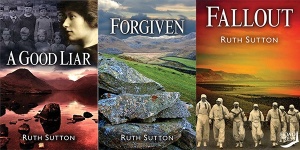
Despite the noisy mysteries of the monster trucks, I had a great time, so good in fact that I didn’t have a chance to see the rest of the show beyond the Local History tent until I carried my stuff to the car at the end of the day, just as the Grand Parade of all the animal winners was processing round the ring. What did I do all day, you might ask. Well, I stood in front of the home-made display explaining and illustrating my novels, talked to people who passed by, and sold a heap of books as well. There were some great conversations, about the settings of my trilogy, which book readers preferred, and why, and the local events that form the background of the plots. A couple stopped by, and the man stared at the cover of the third book ‘Fallout’, which depicts some of the men who went to fight the fire in the nuclear reactor at Windscale in 1957, wearing their protective suits and helmets. He pointed at one of the men in the line. ‘That’s my Dad,’ he said. I was thrilled to have found such a close connection to this iconic event in Cumbria’s history. He was thrilled to see his Dad on the front cover of a book, albeit unrecognisable in his anti-contamination gear. The man was so thrilled he bought the whole trilogy. I did assiduous research for the Windscale details, and I hope this reader finds the result interesting at a personal level.
I can’t remember how many people came by to tell me that they’d read and enjoyed my books and to enquire about the next one. And there was the usual number of people who told me how many others they had lent their copies to. Sometimes books lent out don’t come back, and there’s good business in replacing them, which is fine.
There’s a special reason why I enjoy the Gosforth Show in particular. In the second book of the trilogy ‘Forgiven’ a key scene is set at this show, in 1947, which marks another backward step in the relationship between my flawed and sometimes thoughtless heroine Jessie and her daughter-in-law Maggie. Writing it made me wince and smile simultaneously. As one of my readers has told me, ‘That Jessie, sometimes I could slap her.’
By the end of the day I’d sold more books than I would sell through other outlets in a month or more. It meant standing on damp grass in a draughty tent for five hours, but so what. When you self-publish that’s part of what you sign up for, and I’m lucky that I enjoy it so much. On Saturday September 3rd I’m doing a workshop at the Borderlines Book Festival in Carlisle. It’s called ‘Successful Self-Publishing’ which might be on the optimistic side, but it’s a better title than ‘How to try really hard to self publish without losing money’. I’m learning all the time and it’ll be fun to share, and to find out how other people are managing too. If you Google ‘Borderlines Carlisle’ you’ll find the details among the workshops at Tullie House, on Sept. 5th at 2-5pm.
by admin | Aug 8, 2015 | Cumbria, Fallout, genre, historical fiction, readers, self-publishing, trilogy, West Cumbria, Windscale fire
One of my gripes about writing and selling novels based where I live, in West Cumbria, is that some booksellers insist on describing them as ‘local fiction’ and condemn them to an out-of-the-way corner of the shop labelled ‘local books’, far away from anything remotely topical or current or interesting. I visited one of these dark places this morning, squeezing through the children’s section and right at the back. One of my precious books sat forlorn on the ‘local fiction’ shelf, its cover bent and scruffy, like a forgotten mongrel at the dogs’ home, silently begging to be taken home. That book must have been there a while: it’s got a long shelf-life, but on the wrong shelf.
One of the reasons for deciding to write historical fiction is that it doesn’t date in the same way as ‘contemporary’ fiction does. The fact that my trilogy is set in the first half of the twentieth century has a bearing on its ‘genre label’ but doesn’t surely preclude its being a relevant and readable set of stories with a central character who is perfectly recognisable in today’s world. The characters are timeless, even though the settings and the details of life are carefully embedded in their age.
The long shelf life I seek for my work is about their relevance to my community and to the readers who both live and visit here. Year after year, people visiting our special region will want something to illuminate its past, won’t they? I want that when I’m travelling. But visiting readers in bookshops also want something that’s visible, not have to ferret round in the back room. As a self-publishing author I enjoy the sense of control it gives me over the look and production of my work. The only thing I have no influence on is how booksellers treat my books. I understand that bookshop window space is at a premium, and that sometimes it is ‘sold’ to the highest bidder or the publisher’s rep with the most clout. I understand it, but it still annoys me. No wonder we self-publishers get a little paranoid about the continuing efforts of the traditional book business to keep us out of the loop, no matter how professional we are.
When I asked the bookseller who had banished two of my three books to the ‘back room’ he seemed to say that a book will be given ‘prominence’ in his crowded shop only when it is new. For a few precious weeks just after publication the third book in the trilogy was indeed in the window, but I don’t have a new book out this summer, so that brief honeymoon is over. Producing a new book may provide fleeting visibility, but what else can I do to keep the existing books in sight, literally and metaphorically?
I could buy advertising space in appropriate papers and magazines, but the cost is usually prohibitive. And I could create my own ‘stories’ for the local press to use. These might be appearances at various events, with some text and the all important pictures. Or it could be a local story, linked to the settings of my books. There have been some good opportunities recently, which I’ve tried to exploit through social media, but not very effectively I fear. This coming week will see a programme on BBC4 about Sellafield, a rarity in itself with the secrecy that surrounds the place. Some people watching may realise for the first time that a reactor fire in 1957 was almost a disaster, with only local know-how and courage saving the day. They could deepen that understanding immeasurably by reading my third book ‘Fallout’ which tells the inside story of the fire through the fictional character of Lawrence Finer, a nuclear physicist seconded to the plant, but how do I let people know that this novel actually exists, and where to find it? Good PR boosts the shelf life of a book, but the effort needs to be made repeatedly There’s definitely a limit to this, and the law of diminishing returns will have an impact too. Refreshing the PR is all part of the author’s constant support of her own sales, and it’s hard work.
I suppose what I really want is that my books should be on the ‘English Classics’ shelf, as enjoyable and relevant in ten or even fifty years time as they are today. That’s ambitious, but I can still live in hope.
by admin | Aug 1, 2015 | A Good Liar, character, Cumbria, Fallout, Forgiven, memory
An email last week (thanks, Lesley) prompted me to think for the first time about book groups reading my books, either as a whole trilogy or just one of the three. I know that the library service in Cumbria has sets of each of the books for loan for this purpose, and I meet people who have read my books with their group, but I didn’t realise that this sometimes entailed using pre-written questions.
I’ve had a go at creating several questions, in the hope that they might engender some interesting discussion. They seem a bit vague and generic, and I’m sure readers can think of better ones for themselves, but here goes. There are four for each book, and three more that apply to the whole trilogy, which could be adapted for any of the books. Some of the questions for an individual book could be applied for the others too. Mix and match.
I would really love to hear these discussions myself!
A Good Liar
1. How are the characters of Jessie and John introduced to the reader? What do you initially feel about them? Do they develop as the story proceeds, and in what ways?
2. What do you make of Jessie’s affair with Andrew? What does it show about her character, and his?
3. Which passages from the book did you particularly enjoy, or not, and why?
4. This was the author’s first novel: what feedback or advice would you offer her for the future?
Forgiven
1. How is life in a mining community conveyed? Did you find it convincing?
2. Jessie’s independence is threatened in various ways during this story. How does she deal with these developments, and how do you feel about the choices she makes?
3. Do you believe that Maggie genuinely loves John, or is she attracted by what he can offer her?
4. How does the relationship between Jessie and Agnes develop? (This is especially interesting if you’ve witnessed it from the beginning in A Good Liar). What do you think about Agnes’ motives and behaviour?
Fallout
1. How is the character of Lawrence Finer introduced? Do you find him convincing, and what does he add to the story?
2. Do the technical details in this book about the Windscale reactor and the 1957 fire interest you? What could the author have done to improve this aspect of the story?
3. Some of the characters, e.g. Tom Tuohy, were real people working at Windscale in 1957. How does the author weave together fact and fiction. Does it work?
4. The ending of the book, and of the whole trilogy, is left open-ended. Is this satisfying? How would you have liked the book to end?
Between the Mountains and the Sea: the trilogy as a whole
1. Three different communities and decades are explored during the trilogy: what sense did you get of time and place in each of them? Were they convincing and interesting?
2. Does the dialogue contribute to your understanding of the characters? What did you like or dislike about the approach to dialogue?
3. What issues does an author have to consider when writing a trilogy? How has the author dealt with some of these issues?
If you find these questions useful, or have some better ones, let me know. And if you actually use them for a book group discussion, I’d love to know that too, and anything of the feedback or interesting insights that resulted. The next book Cruel Tide, due out in November 2015 is a crime story, and I think the questions might be a bit different.
by admin | May 16, 2015 | Cumbria, Lake District, readers, self-publishing, selling, trilogy
A group asked me to talk about publishing my own books, and I heard myself saying to them ‘Publishing is the easy part, selling is much harder’. For me, that’s true, because getting my work into the hands of readers is part of what motivates me to write in the first place. I’ve been struck recently by the number of people who claim to be writing just for the amusement of family and friends, and don’t appear to be interested in reaching readers beyond that group. That’s not enough for me. Maybe because I’m older, I want something to leave behind me, in the memories and on the bookshelves of as many people as possible.
So how do you sell, and how many is enough? As I write this, James Rebanks ‘The Shepherd’s life’ has been in the best seller charts for weeks and must have sold many thousands. It’s a great book, and I’m not begrudging him that success, but he seems to have had some things going for him that the rest of us might not have. Even before the book was published, for example, he had 40,000 Twitter followers, which has since risen to 60,000. If only 10% of those followers bought a book, that’s still a lot of sales! And either through Twitter or his publishers or agent he’s had massive media coverage, which must have helped too.
So how do we lesser mortals sell our books? One way that works for me is to sell directly, usually after doing a presentation or visiting a book club group. People like to buy from the author they’ve just heard from. Fortunately, I really enjoy that side of the business. As a professional presenter in education for decades, I’ve had plenty of practice in marshalling ideas and facts quite fluently without notes and love the stimulus of responding to whatever questions people may have. I can also offer ‘deals’ as I think fit, which makes buying the full trilogy an attractive prospect. I love selling the full set, as it means they may read all three books in the right order and get the reading experience as it was designed to be.
Another route to market for me has been through a local wholesale distributor, Hills of Workington. They take a 50% discount, but they service almost every book retailer and tourist outlet in Cumbria, apart from the south-east corner, and selling to them by the carton is more efficient than trying to reach each outlet myself. The first orders were on sale or return, but that’s not really necessary any more as the three books in my trilogy, all set in Cumbria, sell steadily, and do well in the tourist season. The beauty of historical fiction is that it has an almost infinite shelf-life. The books will have the same appeal to visitors in ten years time as they have now.
Listing the books in both paperback and ebook formats on Amazon and Kindle brings in a steady trickle of orders, and the big national and international distributors Bertrams and Neilsen contact me for books too, but it’s a cumbersome business. I’ve done the workshops about how to increase your ebook sales with promotions, manipulating the ‘best seller’ lists and reducing the price to less than a cup of coffee, but I’m not thrilled about that. If writers like me produce something of worth, it demeans the process if we sell our work for peanuts. And I can’t be bothered obsessing about selling as much as possible if it takes too much of the time I want to spend writing. Some of my time obviously must be devoted to marketing and promotion, but not too much.
So I totter along, wishing I could sell more, longing for the feedback from readers that so rarely comes, thinking about how, where and when to organise my own promotions. Most of the time I enjoy it. I dream of being ‘discovered’ and selling the TV and film rights, not to make a fortune but just to see my stuff reach more people. That would be fun. I need to invest in new ways of doing things, using video on my website for example, or making this blog more entertaining, but that would use creative energy that seems to be constantly diverted into the next book. What I really need is a savvy publicist who’s prepared to work for nothing. Dream on.
How many sales is enough? If I cover the costs of self-publishing to my own high standard, involving proper professional help, that’s enough. My accountant reckoned I should aim to make as much profit over five years as I would done if the money had stayed in my current account, and with interest rates at rock bottom that’s not much. ‘Back yourself’, he said, and I liked the sound of that, so I did.
by admin | Apr 19, 2015 | A Good Liar, cover, Cumbria, Fallout, Forgiven, historical fiction, Lake District, promotion, readers, self-publishing, selling, title
The publication of my second novel ‘Forgiven’ in 2013 felt very stressful, or at least that’s how I remember it. I felt it was better than the first one ‘A Good Liar’ and had certainly been easier to write, taking a year rather than the previous tortuous four year process. But I underestimated how long it would take to get the final stages of the publication business sorted out, and wanted to get it out into the shops as early as possible in the Lake District visitor season, when probably I should have taken decisions more carefully. Patience was never my strong suit.
The main frustration was about the cover. The cover of ‘A Good Liar’ had taken quite a while to put together and consisted of three parts: a old photo of schoolchildren to place the story in its time; an atmospheric picture of Wastwater to reflect the setting; and a profile of a woman to indicate that the protagonist was female. As one of the booksellers told me, ‘It’s a good cover because it tells the reader about what’s inside.’ When it came to part 2 of the trilogy ‘Forgiven’ I struggled first with the title, which doesn’t give much away, but did pick up one of the themes of the book, and I quite like one word titles. The setting was mainly west Cumbria and the town of Whitehaven in the immediate post-war years, with a family of coal miners at the centre of the action. The cover we ended up with was a gorgeous photo of the local landscape in spring, from a photo taken at about this time of year, when the valley floors were bright green with new grass and there was still snow on the fell tops. A lovely image, but it told the reader very little about the book itself.
From the outset, this book has sold less well than ‘A Good Liar’ and when the third in the trilogy was published the following year, that one sold better too. I began to wonder whether one reason for this might be the enigmatic title or cover of ‘Forgiven’. If the author’s name is well-known then I’m not sure that title and cover matter very much. But I’m expecting visitors to Cumbria to pick this book off a shelf and be interested enough in it to buy it, and why would they, really? They don’t know me from a hole in the ground. They need more at first glance than ‘Forgiven’ could offer them. For ebooks the cover matters less, but for a book on a shelf, competing with others in the reader’s view, the cover matters more.
If I’m right about this, I’m asking myself whether I should approach the reprint of ‘Forgiven’ as an opportunity to ‘re-brand’ it with a new cover. The title is fixed and unchangeable, but changing the cover would be easy and there are many precedents for doing so in the traditional publishing world. As a self-publisher I have absolute discretion about how my work should look, and this could be the time to exercise it.
So, I’m back to the age-old question, what makes a good book cover? The bookseller I referred to earlier takes the functional approach: the cover should indicate what’s between the covers. In that case I might need some reference to winter, hard times and to the pits, and perhaps some images of people of the period. In other words, I could use the same formula as we used for the first cover. Or I could use a more striking image, such as the one I chose for book 3 of the trilogy ‘Fallout’, and enjoy the mixed views that followed. The cover of ‘Fallout’ was designed to surprise, if not shock, the reader and succeeded in that intent, for good or ill.
I’ll have a few months to think about it as there are still enough from the first print run of ‘Forgiven’ to see us through this summer’s busy season. Is a picture of an old coal mine a turn-off for the largely female readership my books attract? Should I hold out for an image of the screen lasses, the remarkable women who worked on the surface sorting and grading the coal, despite the copyright issues that we ran into last time? It’ll be interesting to start again and take longer over the design than I did last time, and even more interesting to see whether a different cover affects sales.
The beauty of writing historical fiction is that it doesn’t have a limited shelf-life: it can be as relevant in ten years’ time as it is now. But the down-side of that agelessness is that it can’t burst upon a waiting world as something completely of its time, new fresh, contemporary. Within the historical fiction genre I’ve tried to avoid the Catherine Cookson cliches, and romanticising a past era that was challenging, complicated and fraught with ambivalence. The cover could reflect some of that at least, rather the rather bland if beautiful image it has at present.
Writing this post has made up my mind. I’ll start thinking about the cover of ‘Forgiven’ now and give myself, and the cover designer I work with, more time to make the best choice. And my new crime fiction book which is due out in November will need a brilliant cover too, which should be ticking over in the back of my mind from now on, while I’m still writing the first draft. Not for the first time, I realise that turning thoughts into words – written or spoken – helps me to pin down what I’m thinking about. I’ll be another year older this week, and beyond the age when my mother’s Alzheimers started. I keep looking for signs that my brain is seizing up, but for the time being, thank heaven, ‘cogito ergo sum’.
Recent Comments