by admin | Aug 23, 2015 | cover, Cumbria, fact-based fiction, Fallout, Forgiven, historical fiction, Lake District, promotion, readers, self-publishing, Windscale fire
Last weekend I went to Gosforth Show, my first and possibly my only local show of the season. The summer months here in Cumbria are stuffed with shows: from July to September there’s one every Saturday and Sunday, and sometimes mid-week as well. Some are small, some massive. The biggest ones are generally in the more populous and popular areas of the Lake District, taking advantage of the influx of visitors at this time of the year. The formula is always much the same: local farmers and gardeners present their offerings in a large number of ‘classes’. It could be ‘best Herdwick tup’ (ram), or best calf, or leeks, or sweet peas, or even strawberry jam or Victoria sponge cake. Competition is fierce and the winners are impressive. And of course there are ‘attractions’ such as the ‘monster trucks’ at Gosforth Show this year, which apparently cost a fortune but may have contributed to the biggest numbers ever attending the show. I managed not to see them, but from my spot in the Local History tent the noise was deafening. During the display women of my age came to visit me, asking ‘Why does anyone want to watch those ghastly things?’, to which I had no adequate response.
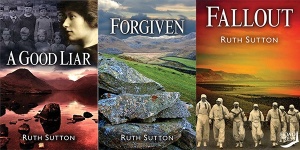
Despite the noisy mysteries of the monster trucks, I had a great time, so good in fact that I didn’t have a chance to see the rest of the show beyond the Local History tent until I carried my stuff to the car at the end of the day, just as the Grand Parade of all the animal winners was processing round the ring. What did I do all day, you might ask. Well, I stood in front of the home-made display explaining and illustrating my novels, talked to people who passed by, and sold a heap of books as well. There were some great conversations, about the settings of my trilogy, which book readers preferred, and why, and the local events that form the background of the plots. A couple stopped by, and the man stared at the cover of the third book ‘Fallout’, which depicts some of the men who went to fight the fire in the nuclear reactor at Windscale in 1957, wearing their protective suits and helmets. He pointed at one of the men in the line. ‘That’s my Dad,’ he said. I was thrilled to have found such a close connection to this iconic event in Cumbria’s history. He was thrilled to see his Dad on the front cover of a book, albeit unrecognisable in his anti-contamination gear. The man was so thrilled he bought the whole trilogy. I did assiduous research for the Windscale details, and I hope this reader finds the result interesting at a personal level.
I can’t remember how many people came by to tell me that they’d read and enjoyed my books and to enquire about the next one. And there was the usual number of people who told me how many others they had lent their copies to. Sometimes books lent out don’t come back, and there’s good business in replacing them, which is fine.
There’s a special reason why I enjoy the Gosforth Show in particular. In the second book of the trilogy ‘Forgiven’ a key scene is set at this show, in 1947, which marks another backward step in the relationship between my flawed and sometimes thoughtless heroine Jessie and her daughter-in-law Maggie. Writing it made me wince and smile simultaneously. As one of my readers has told me, ‘That Jessie, sometimes I could slap her.’
By the end of the day I’d sold more books than I would sell through other outlets in a month or more. It meant standing on damp grass in a draughty tent for five hours, but so what. When you self-publish that’s part of what you sign up for, and I’m lucky that I enjoy it so much. On Saturday September 3rd I’m doing a workshop at the Borderlines Book Festival in Carlisle. It’s called ‘Successful Self-Publishing’ which might be on the optimistic side, but it’s a better title than ‘How to try really hard to self publish without losing money’. I’m learning all the time and it’ll be fun to share, and to find out how other people are managing too. If you Google ‘Borderlines Carlisle’ you’ll find the details among the workshops at Tullie House, on Sept. 5th at 2-5pm.
by admin | Aug 16, 2015 | Uncategorized
Last week brought the annual visit to the accountan for a review of the year’s business for ‘Ruth Sutton Ltd’ and discussion about the coming year. As I anticipated and had planned for, my ‘real work’ as an education consultant is finally winding down after 27 very busy years since 1988 when I left my safe salaried job and set off on my own. In the early years when I was ridiculously busy my accountant wanted me to arrange things differently so that I could make more money and grow my business, which is what he assumed I really wanted to do. This would have involved ‘packaging’ my services with special resources that could be sold to a larger numbers of clients, or ‘franchising’ my consultancy, bringing in others who would do the work under my ‘brand’ and would be hired out to clients under my direction and supervision. ‘As it stands’, he said, ‘you can only be in one place at once, so there’s a clear ceiling to the work you can do and therefore the money you can earn.’ That was true, but it still didn’t convince me to go down the road he was suggesting. Professional relationship and trust was at the heart of my work: if there were others whom I could rely on to replicate what I could offer then they would have to be my partners, not my ’employees’, and setting all that up would take time away from the core work I wanted to do and enjoyed.
As time went by, and my work took me regularly all around the UK and then to Canada and New Zealand, I found a special role in putting these various systems in touch with each other, brokering very productive visits and professional sharing and getting great satisfaction from doing so. That was the ‘goodwill’ that had to be quantified when I set up the ‘limited company’ some years later and which was now coming to an end.
I’ve always maintained that an education consultant’s shelf-life is limited, and is also to some degree a function of the regular high quality work s/he is doing with clients at all levels of the education system. Once that work begins to slow down you have less to offer, and at a certain point you should be prepared to ‘shut up and sit down’. I’d seen some of my peers not do this, drifting slowly from the education business into the entertainment business, with the same old routines, presentations, ideas and decontextualised suggestions, – packaged, slick and still financially rewarding but repetitious and well past their sell-by date. ‘Snake oil salesman’ is too harsh a description, but you probably see the problem. The punters themselves often want you to soften and popularise the message, which is flattering, and it’s easy to succumb when they offer you heaps of money and treat you like a celebrity.
So when it comes to winding up my consultancy business, there is no financial or tangible ‘legacy’ product that can be sold, except the private pension money that I’ve assiduously put away over the years and will now pay me a modest and sufficient amount, if I manage it well. The accountant went once again through all the ideas that had first been discussed twenty five years ago, and with the same result. ‘So what have you got out of all those years and all that work?’ he asked. It wasn’t hard to answer that one: twenty five years of travelling the world, working with teachers, school and system leaders in many countries with a view always to improving the quality of real deep learning and teaching that children and young people receive. That work has been a privilege and a pleasure, and I’m rewarded with good friendships all over the world and countless amazing experiences as a traveller, not a tourist. My only regret is that I didn’t keep a more detailed and consistent diary, although I have a shelf-ful of notebooks, as well as books and articles I’ve written over the years.
There are a couple more work commitments in the diary for the coming year, and then I’m done with the education work and able to focus on learning and developing a different set of skills, as a fiction writer who publishes her own work and does all the promotion and marketing herself. That should keep me going for a while. What I want is the recognition that self-publishers writers are usually denied, and an added bonus would be the chance to sell my novels further afield…. and a tv or film deal wouldn’t come amiss as well. Any offers?
by admin | Aug 11, 2015 | Uncategorized
I wonder how long it will take BT OpenReach to find our remote village and get the problem on my telephone line fixed? Until then I’m reduced to going to my daughter’s down the road or to the local cafe to get online, and it feels different, as if I’m encroaching on others and need to hurry up.
So I shall be brief…
Being off line is strangely liberating. I feel less tied to the iPad and the laptop, more free to think without so much external stimulus, like I do when travelling. A possible story line for the next novel is being to float around, in the new space available in my head. I’m also aware of the anxiety that comes with it. Starting another book before the proofs are ready on the current one is probably a bad idea. The final stages of editing need proper focus with the details part of my brain, not the expansive part that generates new stories and ideas. If I knew more about my own brain I could explain this in more grown-up terms, but you probably get the picture.
So for the next few days I shall be reliant on time-consuming processes and visiting to get on-line. I may see more of my grandchildren – a good thing – and/or drink more coffee – not such a good thing. But I shall survive. In the great scheme of things, being off-line is a mere pimple on the nose of life.
by admin | Aug 8, 2015 | Cumbria, Fallout, genre, historical fiction, readers, self-publishing, trilogy, West Cumbria, Windscale fire
One of my gripes about writing and selling novels based where I live, in West Cumbria, is that some booksellers insist on describing them as ‘local fiction’ and condemn them to an out-of-the-way corner of the shop labelled ‘local books’, far away from anything remotely topical or current or interesting. I visited one of these dark places this morning, squeezing through the children’s section and right at the back. One of my precious books sat forlorn on the ‘local fiction’ shelf, its cover bent and scruffy, like a forgotten mongrel at the dogs’ home, silently begging to be taken home. That book must have been there a while: it’s got a long shelf-life, but on the wrong shelf.
One of the reasons for deciding to write historical fiction is that it doesn’t date in the same way as ‘contemporary’ fiction does. The fact that my trilogy is set in the first half of the twentieth century has a bearing on its ‘genre label’ but doesn’t surely preclude its being a relevant and readable set of stories with a central character who is perfectly recognisable in today’s world. The characters are timeless, even though the settings and the details of life are carefully embedded in their age.
The long shelf life I seek for my work is about their relevance to my community and to the readers who both live and visit here. Year after year, people visiting our special region will want something to illuminate its past, won’t they? I want that when I’m travelling. But visiting readers in bookshops also want something that’s visible, not have to ferret round in the back room. As a self-publishing author I enjoy the sense of control it gives me over the look and production of my work. The only thing I have no influence on is how booksellers treat my books. I understand that bookshop window space is at a premium, and that sometimes it is ‘sold’ to the highest bidder or the publisher’s rep with the most clout. I understand it, but it still annoys me. No wonder we self-publishers get a little paranoid about the continuing efforts of the traditional book business to keep us out of the loop, no matter how professional we are.
When I asked the bookseller who had banished two of my three books to the ‘back room’ he seemed to say that a book will be given ‘prominence’ in his crowded shop only when it is new. For a few precious weeks just after publication the third book in the trilogy was indeed in the window, but I don’t have a new book out this summer, so that brief honeymoon is over. Producing a new book may provide fleeting visibility, but what else can I do to keep the existing books in sight, literally and metaphorically?
I could buy advertising space in appropriate papers and magazines, but the cost is usually prohibitive. And I could create my own ‘stories’ for the local press to use. These might be appearances at various events, with some text and the all important pictures. Or it could be a local story, linked to the settings of my books. There have been some good opportunities recently, which I’ve tried to exploit through social media, but not very effectively I fear. This coming week will see a programme on BBC4 about Sellafield, a rarity in itself with the secrecy that surrounds the place. Some people watching may realise for the first time that a reactor fire in 1957 was almost a disaster, with only local know-how and courage saving the day. They could deepen that understanding immeasurably by reading my third book ‘Fallout’ which tells the inside story of the fire through the fictional character of Lawrence Finer, a nuclear physicist seconded to the plant, but how do I let people know that this novel actually exists, and where to find it? Good PR boosts the shelf life of a book, but the effort needs to be made repeatedly There’s definitely a limit to this, and the law of diminishing returns will have an impact too. Refreshing the PR is all part of the author’s constant support of her own sales, and it’s hard work.
I suppose what I really want is that my books should be on the ‘English Classics’ shelf, as enjoyable and relevant in ten or even fifty years time as they are today. That’s ambitious, but I can still live in hope.
by admin | Aug 2, 2015 | Forgiven
It’s interesting how the request for questions about the books started me thinking about them, and what they mean and represent to me, a year or two after writing them. In particular, I’ve been thinking about the title of the second one ‘Forgiven’. As I was writing it, I was very aware of the need – and the difficulty – to forgive ourselves and each other for past mistakes. John needs to forgive his mother, but she sometimes makes it so hard for him to do so. Maggie may need to forgive her mother-in-law for letting go of John as a baby, but she never does. The relationship between Jessie and her Maggie is a classic, never really resolved. There’s a great confrontation between the two of them early on in Forgiven that I really enjoyed writing.
As the second book, Forgiven has always sold less well than the other two, in paperback and on Kindle. Partly I feel that may be about the cover, which gives no indication of what lies within. Or it might be the ‘middle book’ problem, less ‘separate’ than the first of last of the trilogy. Forgiven has less external tension in the plot than the others, but more internal tension, in the relationships. I smiled and cried more writing that one than either of the others. Jessie is her own worst enemy, prickly and careless, but I felt for her. I’d love to know what other readers made of her in ‘Forgiven’. Can we forgive her, and hope she mends her ways, or do we accept her just as she is?
Jessie’s question to Matthew Dawson, her apparently attractive suitor, is ‘Why should I want or accept your forgiveness, when I feel I’ve done nothing to be forgiven for?’ Forgiveness is clearly in her mind a double-edged concept, implying ‘fault’ in the person to be forgiven. Is that always true?
by admin | Aug 1, 2015 | A Good Liar, character, Cumbria, Fallout, Forgiven, memory
An email last week (thanks, Lesley) prompted me to think for the first time about book groups reading my books, either as a whole trilogy or just one of the three. I know that the library service in Cumbria has sets of each of the books for loan for this purpose, and I meet people who have read my books with their group, but I didn’t realise that this sometimes entailed using pre-written questions.
I’ve had a go at creating several questions, in the hope that they might engender some interesting discussion. They seem a bit vague and generic, and I’m sure readers can think of better ones for themselves, but here goes. There are four for each book, and three more that apply to the whole trilogy, which could be adapted for any of the books. Some of the questions for an individual book could be applied for the others too. Mix and match.
I would really love to hear these discussions myself!
A Good Liar
1. How are the characters of Jessie and John introduced to the reader? What do you initially feel about them? Do they develop as the story proceeds, and in what ways?
2. What do you make of Jessie’s affair with Andrew? What does it show about her character, and his?
3. Which passages from the book did you particularly enjoy, or not, and why?
4. This was the author’s first novel: what feedback or advice would you offer her for the future?
Forgiven
1. How is life in a mining community conveyed? Did you find it convincing?
2. Jessie’s independence is threatened in various ways during this story. How does she deal with these developments, and how do you feel about the choices she makes?
3. Do you believe that Maggie genuinely loves John, or is she attracted by what he can offer her?
4. How does the relationship between Jessie and Agnes develop? (This is especially interesting if you’ve witnessed it from the beginning in A Good Liar). What do you think about Agnes’ motives and behaviour?
Fallout
1. How is the character of Lawrence Finer introduced? Do you find him convincing, and what does he add to the story?
2. Do the technical details in this book about the Windscale reactor and the 1957 fire interest you? What could the author have done to improve this aspect of the story?
3. Some of the characters, e.g. Tom Tuohy, were real people working at Windscale in 1957. How does the author weave together fact and fiction. Does it work?
4. The ending of the book, and of the whole trilogy, is left open-ended. Is this satisfying? How would you have liked the book to end?
Between the Mountains and the Sea: the trilogy as a whole
1. Three different communities and decades are explored during the trilogy: what sense did you get of time and place in each of them? Were they convincing and interesting?
2. Does the dialogue contribute to your understanding of the characters? What did you like or dislike about the approach to dialogue?
3. What issues does an author have to consider when writing a trilogy? How has the author dealt with some of these issues?
If you find these questions useful, or have some better ones, let me know. And if you actually use them for a book group discussion, I’d love to know that too, and anything of the feedback or interesting insights that resulted. The next book Cruel Tide, due out in November 2015 is a crime story, and I think the questions might be a bit different.
by admin | Jul 27, 2015 | Uncategorized
On Saturday September 5th, at the Borderlines Book Festival in Carlisle, I’ll be running my first workshop on self-publishing. I’m delighted that they asked me to do something at this event. I went last year and did a very short session on writing local fiction. It was too short to do any justice to such a complex topic, but I enjoyed it, and the rest of the festival was really good too, so I was glad to be part of it.
This time I have a little longer, and the topic is quite specific, or so I thought when I said I would do it. But the more I think about self-publishing, the more complicated and multi-dimensional it seems to become. I’m trying to create some kind of sequence of sub-topics as the basic structure of what I offer, but it’s looking more like a flow chart, with binary choices to be made a various points. The people who present themselves, assuming that some will sign up for it, will all be very different in their motivation, confidence, prior knowledge and aspirations, and I’m struggling to create something that will have a chance of meeting such disparate needs.
The first stage in the flow chart has to be the existence of a ‘product’ – novel, short-story, poem, whatever it may be, – that will actually be worth publishing. Without a well written and crafted ‘thing’ any kind of publishing is premature. We’ll have to address the issue of quality, and the importance of professional editing, although I know right from the off that some people want to self-publish with as little financial outlay as they can possibly manage. How do you persuade someone that getting their well-meaning but amateur friend to edit their work is not a good start?
Given a quality ‘product’, the next step is to consider whether self-publishing is the best choice, rather than putting more energy into finding an agent and thence to ‘traditional’ publication, with most of the decisions taken out of the author’s hands. We will need to look at the pros and cons of self-publishing in some detail, to make sure that anyone choosing that road understands what they’re doing, and why.
If self-publishing is the best option, then another host of variable and choices present themselves, which is where the diversity of the people in the group will probably be most manifest. Some want to publish just for family and friends, others only as ebook, others again – myself included – prefer the paperback as well as ebook option, aware of the costs that can be incurred, including storage if you don’t want to be falling over boxes of books in your home. Keeping precious books in a damp garage isn’t a great idea, and mice love paper.
Whichever self-publishing choice the author makes, books don’t sell themselves. Unless you’re extremely fortunate and well-connected, reviews will be hard to come by, and the mainstream booksellers may not want to put an unknown writer’s self-published stuff on their shelves. So how do you get people to buy your book, once you’ve run through those who know your name and want to support you? At this stage, under the heading of ‘promotion and marketing’, off we go into the development of the ‘author platform’, the very idea of which will make some wince and others lose heart. If you’re starting from scratch, the work involved in developing and connecting the various components of a ‘platform’ – website, blog, Facebook and Twitter presence, and much more – looks daunting, and it takes time.
And after all that effort on the laptop, the digital presence will need to be supplemented with personal appearances, anywhere and everywhere. I sold more books last year at meetings, events and so on than by any other means. and really enjoyed doing so, but I know what a nightmare they might be to others with less experience and practice.
Does self-publishing pay for itself, or even generate some real money? It can, certainly, but that takes a great deal of work and time that could – or should? – be spent on the real business of the writer – writing!
See what I mean? It’s not easy. My challenge is to plan three hours or so of pertinent activity and discussion that will raise these issues and give the participants a chance to work on a plan to take away. If you read this far and fancy joining us, hit the website link at the top of this post and follow the stages to book your place. There’ll be other great sessions to sign up for too, if last year’s successful Borderlines event is anything to go by. I heard Rory Stewart there last year, and Alan Johnson, both talking very impressively about their new ‘conventionally’ published books. For those of us with less clout, the road to publication is more difficult but offers far more control and more income per book too. If self-publication appeals to you, come and work with us on September 5th and we’ll learn together.
by admin | Jul 20, 2015 | crime fiction, Cruel Tide, self-publishing, trilogy
One of the many things that made Margaret Thatcher anathema to me – even now after all these years – was her apparent complete absence of self-doubt. It’s a ‘fundamentalist’ trait, I suppose, which manifests itself in similar ways whatever the beliefs of the believer. I have a reputation – undeserved, surely – for expressing myself quite forcefully at times, about Margaret Thatcher for example, but underneath it all I am frequently assailed by self-doubt and one of those times seems to be upon me now.
The ms of Cruel Tide is with my editor Charlotte and I’ll get it back for approval in a week or so. We’ve corresponded and talked at length about several previous drafts, but even so waiting for her editing suggestions feels like waiting for an exam result. Did I do a good job? Is it really crime fiction or just another character-driven story with ‘events’ like the trilogy that went before it? Was it a good idea to link it to the trilogy, or was that choice driven by commercial considerations? Is Cruel Tide as well-written as it should be? Does the dialogue work? On and on the questions go. I could lay some of them to rest perhaps by re-reading the text yet again, but I daren’t, and anyway it may be too late. Once the production machine begins to hum along there are few opportunities for major changes. Tweaking only from now on, and I do want the book to be ready for the shops well before Christmas. Now I’m thinking like a publisher rather than a writer, but when you self-publish you have to be both.
I was hoping that sales would be quite brisk as the summer moves on and more visitors arrive in the lake District, but things seem to be slow. Ebook sales go up and down without any explanation, and I can’t tell whether any of my promotional activities have any impact on anything except direct sales, which are always good when I’m ‘performing’ somewhere. Fortunately I so enjoy the ‘performing’ element of this work that I will continue to do it regardless of whether it sells books or not. Sometimes I yearn for a larger audience and somewhere other than a village hall or church rooms to do my work, but it’s the same old problem of breaking in to the ‘festivals’ circuit that many self-published authors like me face. What does it take to get enough recognition to be asked to do things that will build a reputation for quality? I know I can engage and entertain larger audiences as I’ve done it for decades in my previous life as an education presenter, but no one in the book business would take any notice of that. On paper I’m another elderly unagented northerner who writes and publishes old-fashioned stories, and I’m popular on the Cumbrian WI circuit. Nothing wrong with that, but it may not get you noticed by people wanting to sell tickets for ‘Words on the Water’ in Keswick or the Hay Festival. I look on Twitter at fellow-writers enjoying their contributions to book festivals and I think ‘I could do that!’
Nothing like a good moan. My partner thinks I should have more faith in myself. ‘Keep going’ he says. ‘The books are good, and eventually someone who matters in the book business will notice them.’ Maybe he’s right, but I’m not certain: the doubt is not enough to stop me thinking about the next book, however, and the current mood will probably pass. In the meantime I wonder if all this introspection is just unnecessary and a waste of energy. I’m incredibly fortunate to be able to live the life I have and afford the luxury of high-quality self-publishing. I’ve been writing fiction for less than five years and hopefully getting better with practice. Self-doubt is probably appropriate and realistic and OK. Get over it.
by admin | Jul 13, 2015 | self-publishing
For a while now I’ve been thinking about doing an audio book, but only recently began to gather all the relevant information about how much it would cost, to decide whether I can afford it, and whether I would ever get a reasonable return. The basic sums are relatively simple: at a commercial recording studio the going rate seems to be around £190 per hour of recording, and I’m told that at 90,000 word book would take around 9 hours. So it’s a lot of money to invest up front, and that’s before the costs of actually getting to the studio. The studios I’ve checked so far are in London, Oxford and Manchester, many hours from my home and I’d have to stay somewhere too. All the studios in Cumbria seem to be devoted to music rather than the spoken word.
The next factor in the equation would be to research the market for the price of downloads and/or CDs, to see how many I would have to sell to get the investment back, or at least not lose an unreasonable amount. Preliminary enquiries confirm that download and CDs cost a good deal more than other formats, but even so I’d have to sell a lot to recover the outlay. I’ve already concluded that self-publishing for me is an enjoyable hobby that just about pays for itself, but only just, and it’s always a risk for those of us who are not prepared to go exclusively to ebooks. If you want to produce a ‘real’ book of commercial quality, there are costs that you cannot guarantee to recoup, and the same goes for audio books.
I’m not planning to pay for an actor to read the story: that would no doubt put the project financially beyond my reach, but also I really want to read it myself. I have a northern but not specifically Cumbrian accent, but I could probably get away with it. More than that, I don’t really trust anyone else to capture the sense of some of the text. I’ve listened to many audio books, usually on long car journeys, and been very struck by how inappropriate and ill-considered some of the reading has been. Too ‘actorly’, if that’s an intelligible word. If I’m choosing an audio book to listen to I always go for the author’s own reading if I can get it, and feel I could do a better job reading my own words. Alice Walker reading ‘Jazz’, or Vikram Seth reading ‘A Suitable Boy’: both have wonderful voices and listening to them was a joy.
There’s more research to do before I make a final decision about whether to do it. Apart from the money, there’s the time to consider. Reading thirty or so chapters to the right standard would require rehearsal and practice that would take far more time than the actual recording. I have a tendency to be impatient and look for shortcuts, but if you want quality there aren’t any shortcuts. What else might I do with the time that this project would take? Start thinking about the next book? Spend more energy seeking out promotional opportunities for my existing books and the new one ‘Cruel Tide’ which is due out in November? Sort out all the images from our trip to Antarctica and Patagonia that I promised to show to my friends and neighbours? We got back from there in March and it’s July already. And I also have hundreds of slides from a solo trip around China in 1986 that I really want to digitise and share, and that task alone would take hours of rather tedious work. Maybe it’s my age, but I feel the passage of time very acutely: it’s a very precious commodity for me and I always want to spend it wisely. Of all the things I could be doing, is making an audio book the best choice? I’d love to hear from anyone who’s done it, to pick their brains and experience.
by admin | Jun 30, 2015 | character, Forgiven, plotting
With novel number 4 all but finished, I find my mind turning on what next. There was an interesting conversation the other day about a possible plot for book 5, and I heard myself saying, ‘Well, I could kill off so-and-so, and have so-and-so falsely accused, etc etc,’ as if my characters are just pawns in my chess game. Which of course they are.
During the very first painful writing experience I recall deciding that one of the main characters should fall seriously ill and might die. I liked this character and had thought a lot about him, his childhood, his anxieties and frustrations, his strengths and talents, and I was proposing to bump him off on a whim, because I wanted to, and more importantly because I could.
As a happily single and self-employed person I must have a need for control over my own life that is perhaps higher than the normal. Creating characters and writing stories about them may be an extension of that inclination to be in charge. Novelists will tell you that their characters have a life of their own, and in their day to day actions that’s true, but ultimately if their creator decides to bump them off, or incapacitate them, they are powerless to resist. The author rules, OK?
By the end of book 2 ‘Forgiven’ I’d decided that one of the characters had outlived her usefulness to the development of the overall story and would have to go. The only question was when and how. In the end I started book 3 with a death, which upset some readers, but ‘tough’. Death is part of life, as are serious illness, unwanted pregnancy, and addictions of various kinds. We need characters who are stable and comfortable and reasonably happy, but they don’t make good stories and usually end up being hapless victims or just a counterpoint to the more interesting complexities of far less likeable people. And I’m the one who gets to decide, who lives, who dies, when, how and to what effect. I need to think about what this says about me.
Recent Comments