by admin | May 28, 2017 | Authenticity, character, crime fiction, Cumbria, fact-based fiction, Fallout, plotting, readers, Unbound, Uncategorized, Windscale fire
Three years ago I was in the final stages of writing my third novel ‘Fallout‘, which had as its backdrop the nuclear reactor accident at Windscale in Cumbria in October 1957.
Deciding on that context for a story about finding love in later life was a gamble. For a start, the background might end up being much more interesting than the main story line. And dealing with a real event was always going to be tricky. It’s a touchy subject here in Cumbria even after sixty years: the final report on the incident used a phrase about ‘local errors of judgement’ that still rankles. (Actually the phrase was inserted into the report by the Macmillan government as a way of explaining the incident to the Americans without blaming the government’s own rushed reactor building programme.) And of course, because it was a ‘real’ incident within living memory it was essential for me – a local ‘offcomer’ – to get the facts right.
The inside story of the reactor fire was a complicated technical issue. How was I going to help the non-scientific reader to understand what was really going on, and why the key the decisions were made? The plan was to place a character on the inside of the Windscale whose job was to ask questions about the operation of the reactor. This character would act as the reader’s ‘friend’, gathering information in an intelligible way. in ‘Fallout’ this character was Lawrence Finer, seconded to Windscale from Harwell, the nuclear research facility near Oxford.
In my next book ‘Burning Secret’ I face the same issue – explaining farming to a non-farming readership, and then clarifying the complications of a catastrophic infection that decimated our farm animals in 2001. I need a character that acts as the ‘guide’ to a specialist subject for a non-specialist audience. Talking to a local dairy farmer last week it occurred to me how to handle this. 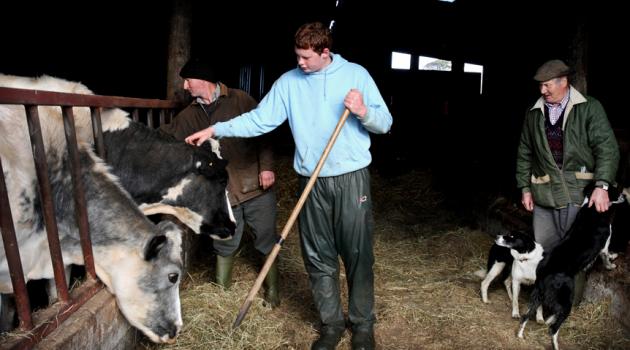 Large dairy farms often employ people to help with milking and the care of the herd, but during the outbreak restrictions were introduced that made it impossible for dairy farm workers to work normally, going home after work and coming back the next day. This particular farm asked a family friend from Liverpool to come and stay on the farm for the duration to help them, and the young man had no experience of farming life. He reacted to the everyday routines of the farm as you or I might, noticing things that the farmers took for granted, asking naive questions, making mistakes through lack of experience. In literary terms, this character’s function is somewhere between the Greek chorus and the gravediggers in Hamlet, and more emotionally detached than the farmers themselves as the outbreak spread ever closer. In a crime story, as this will be, the ‘stranger’ can also be a useful source of tension and mystery. Let’s see how it all turns out.
by admin | May 18, 2017 | crime fiction, Cumbria, fact-based fiction, historical fiction, Lake District, Publishing, readers, Uncategorized
Having done my deal with Unbound.com to publish my next book ‘Burning Secret‘ – a crime story set during the Cumbria foot and mouth disease crisis in 2001- there’s now a link unbound.com/books/burning-secret to the page where the project is explained, illustrated and presented in a video. Alongside all this information is a list of possible pledges that interested people can make, ranging from the simplest – the ebook of ‘Burning Secret’ – to the more elaborate, a customised tour of West Cumbria with the author (me) to find the key sites and settings of my novels. The project needs hundreds of these pledges, small and larger, to reach the target fund and get the book published.
 It’s called ‘crowd-funding’ – a term only vaguely familiar to me before I started down this road. I wonder how it really works: do people actually pay money up front for something that may not appear for months, and if so what motivates them to do so?
Apparently Unbound are interested in this too, and the research they’ve commissioned seems to be saying that people like to feel part of the project: their willingness to join this ‘crowd’ is about being a member of a shared enterprise, an insider, a patron not just a reader.
I have to admit that as a pre-internet adult, growing up before ‘social media’ were even dreamt of, all this has been something of a mystery to me. More importantly, I guess it must be something of a mystery to many of my readers too. Book buyers of my generation expect the book to be finished and ready to buy before we pay our money for it. We might buy online, but this ‘pre-order and be part of the supporters’ club‘ notion may feel odd.
If that’s true, if the baby-boomer generation doesn’t ‘get’ crowd-funding, then I need to think again about finding those pledges. ‘You have to nag people,’ is the advice I get about this, but nagging goes against the grain. I feel I have a relationship with many of the people I’m asking for pledges, and that this relationship could be jeopardised by pushing them to behave in a way that feels unfamiliar. ‘Do this for me, please’ sounds whiney and manipulative.
Clearly I have some thinking to do, or perhaps I’m just reacting too quickly and the crowd-funding process just takes longer than I expected. In the meantime the necessary link https://unbound.com/books/burning-secret is being widely shared, but the numbers of visits to the link far outweigh the number of actual pledges. Is this what happens?
Here’s the question, does the crowd ‘pond’ from which pledges are drawn need to be wide and shallow, or small and deep? Maybe I should focus on getting a smaller number of high-level ‘donations’ and sponsorship, rather than chasing individual pre-orders. Any suggestions?
by admin | May 12, 2017 | crime fiction, crowd-funding, Cumbria, fact-based fiction, genre, Lake District, landscape, Publishing, readers, selling, Uncategorized, West Cumbria
A fter a flurry of activity the Unbound project to publish my next book went live on Monday. I’ve been busy the past few days emailing the link to dozens of people asking for their support. This is the very classy flyer that gives the basic details but there’s much more on this link.
Yesterday I did a marathon tour of some of the libraries at the other end of Cumbria, where foot and mouth was rampant, and heard more memorable stories from the catastrophic outbreak in 2001. It was the smell that is most vividly remembered: animal carcasses, and the smoke from the pyres. A dystopian landscape.
For the next few weeks I’ll be busy getting the link and the flyer shared as widely as possible, and encouraging people to pledge their support for the project anyway they can. If you can help, please do and I’ll be very grateful. Thanks.
by admin | May 7, 2017 | crowd-funding, Cumbria, fact-based fiction, Publishing, readers, Uncategorized, West Cumbria
W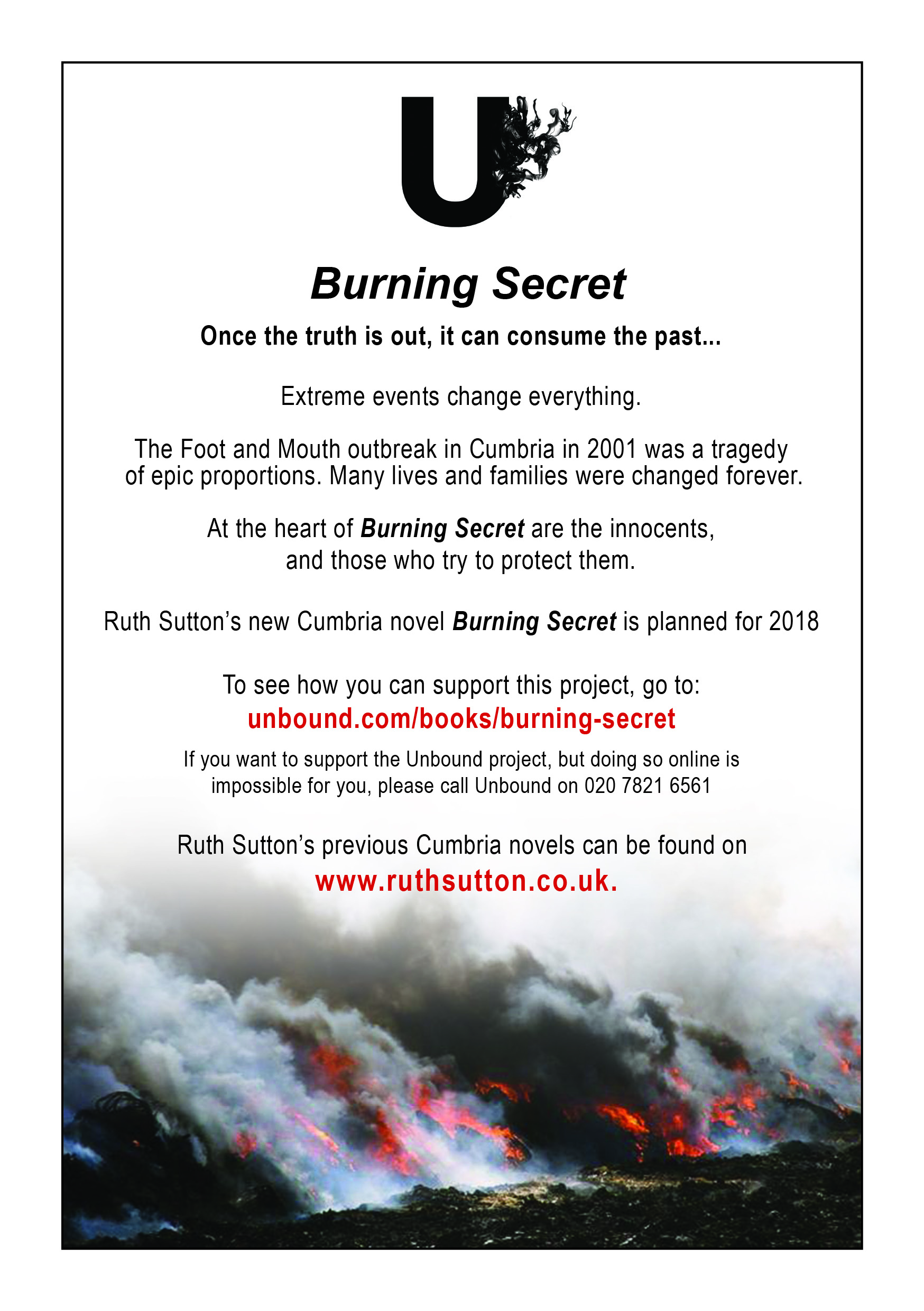 ith only one or two tweaks yet to make, my Unbound project ‘Burning Secret’ should go live tomorrow, Monday May 8th 2017. Then the fun begins, and readers will hopefully begin to pledge their support. There are some good ideas among the pledges, by the way, and definitely worth a look. The link given in the ‘flyer’ to the left isn’t live yet, but if you want to get a sniff of how it will work, go to Unbound and check out some other projects. And keep an eye on FB and Twitter where I’ll let you know the link to go to as soon as it’s ready. I’m finding the whole business exciting, and moderately scary too. It kept me awake for too long last night.
Part of my commitment to the Unbound project is to update my ‘supporters’ regularly about how the project is going, including my actual writing of ‘Burning Secret’. I’ll carry on with this blog of course, and just link across to the Unbound website and vice-versa. Unbound are understandably unwilling to commit right now to a publication date for the the new book, but my target is to have it out by July 2018, and the paperback to follow by Christmas. To achieve that I have to have the first draft finished by November this year, and I’m pretty sure I can do that. With five novels behind me, I’m more experienced and confident, and less prone to paralysing self-doubt. The real task facing me now is not to finish the book by the target date but to do as good a job as the subject matter demands. It needs to be good, really good, to do justice to the horror of what Cumbria went through.
by admin | Apr 30, 2017 | competitions, creativity, Cumbria, Publishing, readers, self-publishing, Uncategorized, West Cumbria
How did this happen, and now that it has, am I up to it?
I started to write relatively late in life: going on a course on ‘How to Write a Novel’ was my 60th birthday present to myself. Four years later I published my first novel ‘A Good Liar’ and four more have followed since then, one each year since 2012. I tried half-heartedly to find an agent or an independent publisher, failed and gave up. Being self-employed for 25 years provided a degree of self-reliance that was useful in the decision to self-publish, and to do so I well as I could, investing my own hard-earned savings where necessary. I did, and it worked, My books have sold thousands of copies, but most of the sales have been within fifty miles of where I live. They’re all set in Cumbria, and this is obviously very attractive both to locals and visitors, but the stories themselves transcend the setting: it’s the people who matter, what they do, how they feel, how they relate to each other and the lives they lead.
Knowing that the stories are wider than the setting, the promotion and distribution problems that all self-published writers face have been frustrating. With few exceptions, the prejudice against self-published books has been obvious: no reviews, no access to mainstream competitions, insufficient ‘celebrity/literary profile’ for acceptance as a speaker at the book festivals, scant regard from buyers for the major booksellers. Fortunately, I enjoy and am good at talking about my work, and do so regularly at libraries, local writers’ groups, and for Women’s Institutes and other organisations. As a result direct sales of my books are a large part of the overall total. The writer in me gets great satisfaction from readers’ appreciation of what I do, but the entrepreneur in me has been frustrated by the book world’s assumption that self-published novels are ‘ipso facto’ second-rate.
In the end, after all my planning, the invitation to move into a wider publishing world came by accident. At the end of one of my library talks a man introduced himself and told me about his daughter who works for a London-based publisher called Unbound. I listened, but people often tell me that they have contacts in the publishing world and almost invariably it comes to nothing. A week later, however, an email arrived from the daughter, a Commissioning Editor with Unbound, who’d been regaled by her parents about my books – which they love – and my talk. We met, we talked, we negotiated, and less than two months later the deal is done: I will publish my next book in 2018 through ‘Unbound’. With a working title of ‘Burning Secret’, it will be a family/police/crime story set in Cumbria in 2001 at the height of the Foot and Mouth outbreak. Next time I’ll explain in detail the stages of writing and publication over the next year or two. For the time being, check on Unbound, and look at ‘How it Works’. In a couple of weeks my project will go live on the Unbound website, video, pitch, pledges, the works. I’ll post regularly about the process here and through the Unbound website. If you want to share the journey, I’d be delighted.
Recent Comments