by admin | Oct 28, 2017 | character, crime fiction, genre, planning, plot devices, plotting, stories, structure, Uncategorized, violence, writing
I came to crime fiction really late. I didn’t publish my first novel until I was 64, and then spent three years on a character driven trilogy before I decided to try crime writing. I read crime stories and I have some idea how they’re constructed and what makes them work. So why not have a go? How hard can it be?
Oh, the misplaced confidence of the (relatively) old!
Online crime writing course: tick. Found and studied my notes on the ‘Three Act Structure’: tick, although I worried that genre protocols might make the writing formulaic. Then I plunged into ‘Cruel Tide’, a story about institutional child abuse, and ignored most of the genre protocols I’d identified. I refused to make it too graphic and violent; I avoided the expected romance between my two main characters, and – mercy! – I left the ending ambivalent, with the goodies thwarted and the baddies apparently getting away with murder, literally.
I thought it was a good first attempt, but some of my readers were fretful. They wanted a ‘cosier’ theme, more romance, and the wicked to be punished. When I wrote the sequel ‘Fatal Reckoning’ I bent towards these expectations a little more, but that’s the end of the plot spoilers. My ebook and Print on Demand publisher, Fahrenheit Press, dubbed the two crime novels ‘Cumbrian noir’ and I was actually quite chuffed about that. ‘Noir’ has great resonance: it conjures up unresolved wickedness, dark landscapes, claustrophobic interiors, moral ambivalence.  If you love ‘Double Indemnity’ you’re a noir fan, and I do. So if I have a crime fiction sub-genre it’s definitely not cosy crime, nor classic police procedural, and there’s no ‘great detective’ who reveals all in the penultimate chapter.
So Cumbrian noir it is, and I decided to have another go, setting the story in one of the darkest times in recent Cumbrian history, the catastrophic foot and mouth disease outbreak of 2001. I’ve reached the point where I’m reasonably happy with Act 1, and Act 3 looked clear, important and achievable. But here’s the hard part, Act 2. Tension has to mount, complications are necessary, a few blind allies and red herrings come in handy. If it all sounds a bit meandering, that’s the problem. You have to pull the reader along into the breathless tension and twists of Act 3 and then leave things feeling reasonably well resolved by the end. Trouble with Act 2 is a common problem, apparently.
When Act 2 isn’t working, you’ve got some choices. A new character? A new sub-plot? An unexpected twist that raises the danger level? Or there’s something more radical, that might take more time to sort out: you can change the ending you’d planned.
Many writers recommend starting with the denouement and planning backwards from there, and it’s tempting. But sometimes as the characters develop they just don’t fit into the dramatic ending that seemed so attractive in your earlier plans. Or you realise that the underpinning theme that’s emerging from the story doesn’t chime with the original ending. You need to take a deep breath, go back to your outline, and start again, at least from the half way point to the end. It feels drastic, and you need to think hard about the next outline before continuing with the first draft, or you could be wasting even more time than you’ve lost already.
That’s my way out: my ending has to change, and I can see Act 2 taking a better shape already. Phew. Hope it works!
by admin | Oct 12, 2017 | character, creativity, crime fiction, plotting, readers, stories, structure, Uncategorized, writing
‘Are you a planner or a ‘pantser’?’ is the question. Being a planner is obvious: the alternative is to ‘fly by the seat of your pants’, hence the use of this odd word. (I could elaborate on the origin of this phrase, but not right now.)
If you’re writing non-fiction or for academic reasons, planning the order of your piece is pretty crucial. Can you imagine an instruction manual written like a novel? But when you’re writing fiction as I am now there are more choices to be made. The ‘pantsers’ make various claims for their preferred approach. Once you have strong characters, they say, these characters will take over and influence the direction of the plot. Another ‘pantser’ rationale is that half the fun of reading mystery, thriller or crime fiction lies in not knowing how the story will end, and the writer needs the same. ‘Where’s the fun in writing?’ a well-known crime writer asked me, ‘if you already know how it’s all going to turn out?’
Could it be that different fictional genres encourage different approaches to planning? If the story is principally character-driven, then surely the development of the characters during the story will drive the shape and narrative of the story. But crime fiction is surely different, isn’t it? Unless the author is capable of holding a mass of detail suspended in her head without the need to write it down in advance. The final stages of a crime story are heavily dependent, it seems to me, on the detail. This could be about ‘chronology’ – when exactly did certain events happen, and in what order? Or it could be about forensic detail and its role in the denouement.
Specific things said or done and mentioned, or not mentioned, in the text are what the reader relies on to work out what actually happened. That’s part of the challenge of crime and mystery fiction: it’s a game between writer and reader, dependent on the careful planting of clues which are then spotted and interpreted by the vigilant reader. If that’s the heart of the genre, it’s really hard to envisage how the writer could succeed without planning.
I need to plan. I wrote my first novel without a proper plan and got into a terrible mess as a result. It took two years to disentangle the web of plot, sub-plots,  confusions and unnecessary scenes and characters, and once or twice the whole thing nearly ended up in the bin. Never again, and as I turned towards crime fiction the need for planning became more intense. There’s still fun in working out how all the threads will tie together, and how the reader will be keep on turning the pages, but the fun’s now in the planning, not in the actual first draft.
The planning takes time, going back and forth, adjusting, adding detail, making sure the backstory fits together and propels the action forwards. For the structure of the story, that’s the creative stage. When the first draft is started, following the narrative structure established in the plan, then the creativity of language, dialogue and setting are to the fore. For me, it’s the plan that enables me to write quickly and fluently: without the detailed outline I’m constantly stopping and starting, losing the flow.
So, are you a planner or a pantser?
In next week’s post, I’ll try to explain how I actually plan. It’s pretty messy!
by admin | Sep 10, 2017 | 'unreliable narrator', character, crime fiction, planning, point of view, Uncategorized
The opening chapters of any novel are crucial. You have to give readers some information to locate the story and the people, and enough to intrigue them and make them want to read on. There has to be some sense of foreboding, or puzzle, or a hint that things may not be as they appear to be.

That sounds easy enough, but it’s actually a difficult balance to find: a classic ‘Goldilocks’ question, not too little, not too much. If the reader is given absolutely no clue, however subtle, about what might be coming, the story can quickly turn into ‘one shock after another’ with motiveless action and surprise for its own sake. I don’t like that as a reader: it feels manipulative and lazy, and I don’t want to do that as a writer. Too much hinting or heralding doesn’t work either: that feels patronising, as if the reader has to be hit over the head with something to notice it. The ‘Goldilocks’ solution is to offer just the merest mention in passing, so easily missed that the reader finds herself leafing back later, to check whether they actually read it at all, or just imagined it.
The opening chapters of this new book – emerging painfully through the exercise of my slowly mending shoulder ligaments – is a stop and start affair as I struggle to find the right balance. One word, just one word, can make such a difference. As ever, adverbs are to be avoided wherever possible, so the reader is only offered what is done, not how it’s done. The character isn’t thinking about the ‘how’ – why should they, in the privacy of their own space? – so the reader should be allowed only what is seen or heard, unadorned by any authorial intervention.
The other challenge in the opening chapters of this particular story is to present several thousand words from the POV of an adolescent. The reader is to be offered only what the young person sees, hears and experiences. I’m having to remember the mannerisms and reactions of young people I’ve worked with as a teacher over many years, the swings of mood, the partially-informed judgements, the speech patterns. I have a relative of roughly the same age too, but she’s such a different person from the character I’m working with that using her as the example might not be helpful. Much of the ensuing plot hinges around the reactions of this character, and the ways in which new circumstances can provoke change, as well as the rapid changes that always surround early adolescence and puberty.
With all this buzzing in my head, there’s serious frustration in only being able to type for a few minutes at a time. I’m told by everyone that I must be patient, that ligaments and tendons take a long time to heal. I know that, but it’s still galling. I probably need to ration myself: no email, no blogging, until and unless the necessary daily book words targets is reached. Discipline, Ruth. Discipline!
by admin | Aug 26, 2017 | accident, slow writing,, character, crime fiction, opening paragraph, plot devices, plotting, point of view, readers, structure, Uncategorized
My temporary living space is looking pretty well organised now (check previous posts to see what this is all about). And my head is getting round the new situation too: instead of fretting about the necessary confinement I’m using the time to tackle something that’s been overshadowed by health issues for a a couple of weeks – starting the first draft of the new book.

The outline is pretty well sorted, apart from the final denouement which I want to leave loose for now. So first thing this morning I split my screen, posted the outline of Chapter 1 on one side and pulled up a blank document on the other headed, ‘Burning Secret Chapter 1’. The title may change, but it’ll do for now.
Immediately at this point the writer faces a choice about ‘point of view’. Whose eyes am I looking through in this scene? Whose head am I inside, and what does this person see, hear, do and feel? What are the implications of this choice, and is it significant for the reader? It’s a chance to clarify who is at the centre of the story, or possibly to catch the reader off-guard. Do you remember the film ‘Psycho’? For the first several minutes of that Hitchcock masterpiece the viewer thinks they’re being told a story about Janet Leigh’s character having an affair. All the action is from her point of view, until in an iconic shocking twist her character is gone and we are jolted into another story. The decision about the first POV the reader encounters is one the writer needs to think carefully about.
For this book I’ve decided that POV should stay the same for the whole of the first chapter. The setting, both time and place, is quite complicated and one POV is probably enough for the reader to manage. Perhaps at the chapter’s end the hook to draw the reader forward could be the introduction of a new POV, as the story begins to unfold. 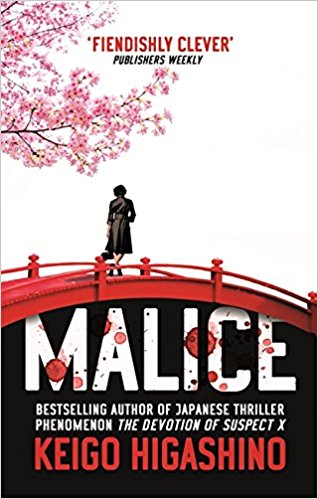
I read an excellent Japanese crime story recently, – ‘Malice’ by Keigo Higashino – at the end of which there was an interview with the author about the techniques he’d used. One of these was to give the reader an early memorable snippet of information about a key character that would be crucial in establishing whether the character was trustworthy or likeable. With that impression established, the reader would interpret the character’s behaviour through that lens. ‘First impressions count’ is the message, and those impressions are manipulated by the author.
So, the choice of character for the first POV, the information the reader is offered, the source of that information and what it signifies, are all Chapter One decisions. However well I’ve planned, much of this subtlety only presents itself when the actual first draft is being written. And that’s what I started on yesterday. I couldn’t write for long because of the sore shoulder, and I’m writing this post early so I can rest for a while before going back to Chapter One later in the morning. Pacing myself like this is useful as it makes me think more about what I’m doing and why, instead of just racing on.
For those of you who are new to this blog, I’m confined to the house having injured myself in a fall, and trying to use this as an opportunity for achievement, not just a source of frustration. It’s Day 2 of a ten day confinement: I hope the good intentions can be sustained. While the rest of country is starting the busiest holiday weekend of the year I shall be quiet in my small space and live inside my head. And if I need distractionthere’s a cricket test match to listen to on the radio. What more could I want?
by admin | Aug 10, 2017 | Authenticity, community, crime fiction, Cumbria, Explicit details, fact-based fiction, historic child abuse enquiry, historical fiction, planning, research, stories, Uncategorized, West Cumbria

‘The horse’s mouth’…where did that phrase come from? And how did it come to mean ‘authentic first-hand information’? However that happened, I’m learning yet again just how powerful such information is when writing a story set in the recent past.
The first novel I wrote was set in 1937, too far back for me to find real people to talk to about how they lived their lives, and I had to be content with first hand accounts in print. The next one, set in 1947, lent itself to listening to people who were around at the time and had stories to tell. I also found the transcript of the National Coal Board’s enquiry into the pit accident in Whitehaven in August 1947 which provided first hand testimony in the witnesses’ own words. By the time I reached the third novel, set in and around the Windscale nuclear power plant in 1957, I was able to find loads of people who remembered the reactor fire there in rich detail, as well as Youtube footage and other contemporary accounts.
The first two crime novels, ‘Cruel Tide’ and ‘Fatal Reckoning’ were set locally but dealt with the issue of institutional child abuse, of which they were no cases from my chosen area that I could draw upon. I relied instead on the report of the enquiry into events at the Kincora boys’ home in Belfast, and the news items that are painfully frequent as historic cases are uncovered.
The novel I’m working on now is set during the 2001 foot and mouth outbreak in Cumbria. There are two sets of factual details I have to get right. One is about the disease itself and its impact on the area. The other is about methods of policing at that time, so that I can ensure that the ‘crime detection’ aspects of the novel are accurate. Family dramas are as old as the hills, but the contexts in which they play out change with the times.
The historian in me loves digging around to find the the best information, and although books and online research are useful there’s really nothing as rich or satisfying as listening to people who lived through the events I’m describing. So far I’ve talked in depth to two CID people who were serving officers in Cumbria at that time, a local vet who played a significant role right through the FMD outbreak, and a man whose job it was to value the farm animals before they were killed. Incidentally, some of the animals were actually free of the disease but were victims of the need to prevent its spread. The memories of my interviewees are raw: it was both cathartic and painful to share them with me. Next I’ll be talking to another person, who liaised with the army and the Ministry of Agriculture, Fisheries and Food (as it was in 2001), and to a forensics expert who was professionally active at that time.
The end product of all this activity will be a novel which will also hopefully be a chronicle of a particular time and place, and a community in crisis. This is the community I will live in for the rest of my life and it’s very close to my heart. I owe it to the people here to get it right, and to weave the fictional story and the factual background together in a way that does justice to both. It’s the people, – their memories, their insights and the words they use – that bring life and authenticity to the writing. It’s also one the most fascinating part of my various writing projects, and I’m really grateful to those who are willing to talk to me.
And I still don’t know how and why it came to be known as ‘straight from the horse’s mouth’.
Do you?
by admin | Jul 26, 2017 | pace, planning, plotting, research, stories, Uncategorized
Sex and money are powerful human motivators. Almost all the great stories involve one or the other, or both. What can I learn from this?
My new book is taking shape, in chapter outlines not a first draft as yet, and it’s at this stage that I begin to look at the movement in the story, how it rattles along, what makes the reader want to turn the pages. At the root of it all is the energy generated by the characters themselves, faced with the circumstances that I have created for them. What makes them act they way they do? Are sex and money critical in this story too?
Having left myself more space this time to think about the story rather than ploughing on quickly to meet the self-imposed target of ‘one book each year’, I’m interested to see how the characters are developing in my head. Straight-forward ‘goodies’ and ‘baddies’ are too easy: there need to be layers, nuances and contradictions that push the reader one way and then another as the story unfolds. I’m asking the ‘what if?’ questions about my story, and it seems to be working. At some point, when all thirty or so chapters are sketched out, I’ll start the first draft. Even then, details and complications will come to me and have to be incorporated, but hopefully without too many ramifications for earlier parts of the plot.
Another useful effect of spending longer thinking before I write is that I forget great chunks of the research. The things that remain are the precious bits that stay lodged in the memory when the rest has gone – the ‘nuggets’. Nothing bogs a story down as fast as too much extraneous detail which the writer has dredged up through painstaking research and is consequently determined to use. The trick is to identify the ‘nuggets’ and use them sparingly, adding colour to the story without slowing it down.
Sex and money aren’t the only things that drive action: love, fear, survival – they all play a part. Theymay manifest themselves differently in different eras and societies, but they never lose their relevance and their potency.
Recent Comments