by admin | Jun 19, 2016 | cover, crime fiction, Cruel Tide, Morecambe Bay, Publishing, readers, self-publishing, title, Uncategorized
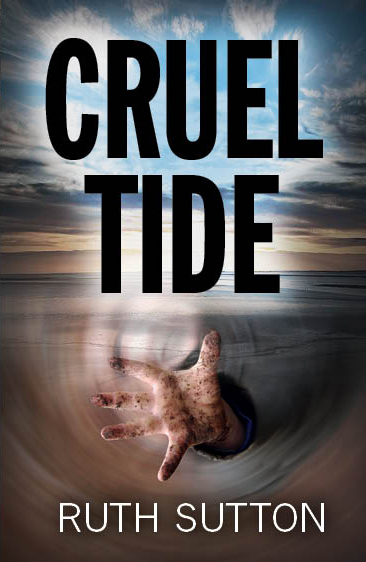
I always struggle with titles, and then with the cover image that should illuminate the title and engage the reader: as an independent author/publisher, these decisions are all mine. The image on the cover of ‘Cruel Tide’ developed before I even started the book. It came to me when I did the walk across Morecambe Bay and was struck by the menace of quicksand very close to the northern shore. The snaking, threatening tide that covers these huge mudflats twice every day connected with another cruel tide – of abuse, cover-up and corruption that have damaged so many children’s lives. The decision about both title and cover came to me quite quickly.
Not so with the sequel to ‘Cruel TideI’ that I’m currently completing. My editor Charlotte and I have brainstormed possible titles, but nothing really stood out. Then in the final stages of the first draft, in one of those times when the story seems to be writing itself, the words ‘Seize the Day’ became suddenly significant and I could see them on the cover, with a dark image of one of the settings – no details for fear of plot-spoiling.
The first thing you do is check how many other books already exist with that title. Of course there are several, but then you have to take them one at a time and decide whether the replication is significant. The most recent was non-fiction, an autobiography, so that was OK. Another appeared to be a religious tract, too different to bother about. There was one fiction book, but a very different genre.
I think I have my title. Next I’ll think hard about the image, and start working with the cover designer Kevin Ancient who did such a wonderful job with ‘Cruel Tide’. Crime fiction covers seem to be have some common characteristics, to ensure that readers understand what may lie between the covers. Decisions to make. Watch this space.
by admin | Apr 29, 2016 | costs, Publishing, readers, self-publishing, self-publishing workshops, writing
The reader who approached me at a recent library talk waited until the end of the event and spoke to me quietly. “I really enjoy your books,” she began, and I could tell there was a ‘but’ on its way. “But, I’ve noticed a few mistakes, nothing major, just little things….lots of little things.” My heart sank, but I rallied and mumbled something about the odd inevitable proof-reading problem. “Could you let me know what you’ve found?” I asked her, and thought not much more of it, until the copy of the book in question arrived with the errors painstakingly marked up and a forest of little stickers marking the pages to be looked at.
I am slowing recovering from the shock and embarrassment of what was revealed. Even when I found the delicate pencil stroke in the margin and looked for the error it sometimes took two or three attempts to even see it. They were little things: often an extra or missing short word, and eyes reading quickly for the sense of the sentence floated over without registering it. Very few readers have mentioned the errors to me, and I must have read the offending sections many times and never noticed either, but it’s still unacceptable in properly published material.
Crying and spilled milk come to mind. The book is out there, and the inquest among the editorial team has begun. All of us recognise how the errors have happened, mainly because the people trying to proof-read have been involved in the development and drafting of the story right from the beginning. Familiarity hasn’t bred contempt, just a failure to see each word on the page separate from the context that we all know so well. It has taken a fresh reader, who must read more slowly and carefully than me, to spot what we couldn’t see. I’m very grateful to my amateur proof-reader, and have told her so. She could have been aggressive about it and got my defences up, but her approach was perfect and it worked. If she’s prepared to proof-read all my previous books before they go for reprint, I’d be delighted.
As a self-published author I have the same responsibilities to my readers as a traditional publisher. If it costs more money – probably an additional £400 or so – to hire a professional outside reader for the second proof read immediately before printing, and if that process takes a week or two on top of an already tight schedule to publish one book a year, well that’s what it has to take, and it will be done.
Advice to self-publishers? Don’t cut corners on proof-reading, and don’t try to do it yourself. Once the book is out there with your name on it, the mistakes will haunt and taunt you. Your reputation and your readers deserve the best. Mea Culpa.
by admin | Mar 20, 2016 | costs, formula, genre, Publishing, self-publishing, Uncategorized
Sometimes a thought arrives by a very circuitous route: this one started with reading ‘Lancashire Life’, one of those glossy mags that abound in England and mirror the lives of that tiny fraction of the population that can afford what lies within. As I am not one of that tiny fraction, I bought a copy last month because they were running a review of my first crime novel ‘Cruel Tide’ and I was chuffed and curious. The book page was at the back and what struck me as I leafed through to find it was the number of advertisements for wedding venues, bridal shops, ‘mother-of-the bride’ shops and so on. This in turn prompted memories of some recent family weddings where the purpose of the exercise seemed to have been lost in a morass of unnecessary and costly rituals, mostly imported from the US. That experience, reinforced by the countless wedding industry adverts made me wonder, yet again, about what drives people to want what others have, and to do what others do, rather than stick to what they feel comfortable with. Why do we ape others rather than represent our true selves?
The more I see of the publishing industry, the more of a ‘business’ and less of a creative enterprise it seems to be, at least currently. My impression is that the current obsession with ‘fads’ is relatively recent, probably since the acquisition of money to stay afloat in troubled times became the main imperative. Editors and publishers are no longer the gatekeepers of quality in this enterprise. Their role has been replaced by the agent, a mediator between the writer and her means of public expression, who lives by taking a percentage of the writer’s earnings. If your livelihood depends on the certainty of financial success, and the people you are selling to are also risk-averse, all of you are intensely concerned with finding books that will sell big and sell fast, creating and then riding a public wave which is powerful but transient, a wave to be surfed not a long-distance ocean swell.
This is the breeding ground of trends, fads, fashion, whatever term you choose. Everyone in the book business is now on the look out for sure things, and the only evidence they have to use is the last sure thing. If we analyse what made the last successful book popular and replicate it, then we might catch the wave before it fades and make some money. The problem for books is that they cannot, or should not, be written fast. If you want to catch the wave, you haven’t got time for a book to be written. Instead you go yet again through the pile of stuff you already have, looking for the desired combination of criteria. Speed is of the essence. No time to read more than a chapter or two, if that. Agents talk constantly about ‘falling in love’ with a book as their only criterion for choosing one book over another. This has to be a ‘coup de foudre’ not a long, measured appreciation. Quick flick: does it have the necessary genre features that the last best-seller had? Does it fit the bill? Is the author photogenic and have a good story? Can we sell this big and fast? If so, let’s go. If not, throw it back onto the ever-mounting slush pile.
I know it’s not as simple as this, but to someone on the outside of the conventional book business looking in, this is how it feels. Writing and publishing a book, like planning a wedding, can be an expression of your approach to life and your individual values. Or it can be a way of demonstrating how fashion conscious and competitive you are. The big fashionable wedding will get into the glossy magazines, where the wedding planners’ choices and expenses will be scrutinised by others. And the publishers’ choice of a handful of manuscripts, which are then lavished with expensive editorial and promotional support, will get noticed by the book business cogniscenti, which then adds to the hype and presumably increases sales. Fads and fashions create a barrier between the ‘in-crowd’ and the ‘out-crowd’: the in-crowd are necessarily and frenetically peer conscious and competitive, while self-publishing outsiders like myself are free to follow our own paths with some chance of staying true to ourselves.
by admin | Mar 8, 2016 | costs, marketing, Pricing, Publishing, readers, research, self-publishing, self-publishing workshops, Uncategorized
There was some very interesting discussion of this question at a workshop on self-publishing I led recently. Sixteen or so people round the table all had different goals, starting points, skills, strategies and experiences. Some did everything themselves, and used time and perseverance rather than money for the project. Others – me included -needed professional help with all or part of the process, and were able and prepared to pay for it. Others spent all their money on producing the book, but then found themselves with nothing left over to use for promotion, without which their beautiful books were still in their boxes cluttering up the house. Some just about covered their costs; some were nowhere near doing so; one or two had lost more than they could afford. I’d expected at least some stories of financial success, but heard none. Maybe the quiet ones at the table were doing better than they wanted to share.
There’s no question that almost all self-publishing projects will cost you something, either money or time, and probably both. There’s also no doubt that producing an ebook is much easier and cheaper than any other format, and you can sell heaps if you put a ludicrously low price on it, but the effect on sales is ephemeral. Publishing a paperback is a more difficult, but carries with it many more opportunities for promotion and direct sales.
I’m often surprised that many aspiring self-publishers don’t appear to have thought the process through, although that’s understandable given its complexity. If you truly understood the whole process it might be so daunting that you would never even start. One of the more unfortunate of the workshop participants regretted that she hadn’t attended a workshop like this two years before, and we realised why when she recounted – very bravely I thought – the series of mistakes she had made and the loss she’d incurred.
I may have had some advantage in this ‘business project’ game having been self-employed for many years, and having some idea of how to think ahead financially. Before I took the decision to self-publish I knew enough to calculate how many books I would need to sell, at what price, to retrieve the money I had shelled out at the start on the costs of ensuring a high quality paperback. The costs were for critique, editing, design and printing, and came to around £5000 for a 1500 print run. I also knew that bulk printing is cheaper than ‘print on demand’ (POD), and that unit costs are a function of quantity. How did I know that? I did enough initial research to think through some of the details and their implications. I was then able to work out how long it might take to recoup the money, and an approximate ‘rate of sale’. I reckoned it might take two years to recoup the outlay on the 1500 print run, and that turned out to be about right, although the necessary promotion strategy developed very slowly. I should have thought longer and harder about ‘How will people know about your book and why should they want to buy it?’
Once printed, and before sale, the books have to be stored somewhere. I ended up paying for dry secure storage, although I could at a pinch have saved that money by persuading friends and family to store a few boxes each for me. When the first print run was all sold, at a profit of about £4 per book, and I could reprint, then the the unit production cost would go down by about 50% while the price would remain the same, which makes for more profit. I priced the ebooks so that they too would generate about £3-4 each, as the up front costs are minimal. I have used Kindle Direct Publishing, which seemed very complicated to start with and required patience to reach any level of confidence. It’s paying off though: ebooks sales are steadily increasing, and £80-£100 per month is quite a healthy return, in my terms at least. The more books you have to sell, the better, but the outlay of time and investment to produce one book each year, as I currently do, is very demanding for someone with a job or a family, or both.
None of this is rocket science. But listening to people’s experiences the other day I realised what a struggle some self-publishers have. One person had sent off their precious manuscript to an outfit who promised to publish and make her rich. She has not seen any money, as the company she’d trusted went bankrupt, having sold her work on to another bunch of charlatans who also went down. What a mess. Now she has no money left to find out what she may be entitled to, and is lost the commercial maze that she tried unsuccessfully to avoid in the first place.
There’s lots more to say about the financial aspects of self-publishing, and I’ll hold some of it for future posts. I hope my recent two-hour workshop was helpful, although it could have been longer, and pressure of time didn’t enable me to get detailed feedback. There are so many writers out there considering self-publishing, and so many unscrupulous people keen to exploit that interest, that I find myself wanting to help with the basic practical details. Will running workshops on self-publishing generate greater sales of my books? I doubt it, but it feels like something that needs doing.
by admin | Jan 31, 2016 | promotion, Publishing, readers, self-publishing, selling, title
As any regular reader of my blog will know, I’ve always been puzzled by the complexities of ‘genre’ and its effect on those in the book business whose role is to decide what gets published and what doesn’t. Apparently in the latest edition of the ‘Bookseller’ magazine, which I haven’t seen myself, is an article about a new ‘sub-genre’ label ‘grip-lit’, a term used to describe psychological thrillers, such as ‘Gone Girl’ and ‘Girl on a Train’. (I’ve already noted the repeat of ‘girl’ in the title, to bring one’s work instantly to the notice of a literary agent.) ‘Grip lit’ is hardly a new idea; it’s been around for decades, displaced more recently by the new wave of ‘detectives’. Perhaps literary fashion, like its clothing counterpart, has a ‘retro’ phase, when the delights of a previous era are re-discovered and claimed by a younger generation.
If genre is indeed driven by the vagaries of fashion, writers like myself face some choices. We can scour the landscape of current trends to find what sells, analyse the component parts and imitate them as quickly as possible, before the trend fades. And if we’re really clever, we’ll use a trendy title book too. Alternatively, we could aspire to something more timeless and run the risk of being ignored by the bandwagons that sweep by so relentlessly. The beauty of aiming for the timeless is that the books’ shelf life is much longer. If you’re self-publishing in paperback – which you probably are as no agent is interested in anything so untrendy – shelf life is an important consideration. Self-publishers can’t afford the ‘launch’ and promotion budgets available to traditionally published books, and have to rely instead on steady sales over a longer period to get any return on the initial investment.
In the Saturday Guardian review section, a few pages on from the piece about ‘grip lit’, there is an article by Hilary Mantel about the life and work of Elizabeth Jane Howard. Howard’s work is often disparaged, with a genre definition of ‘by women, for women’. Mantel believes that this category existed ‘until very recently’, but I think it’s still around, and just as disparaged as ever. The difference is that now such novels rarely if ever penetrate the net thrown around the publishing business by the professional agents on whom the business now relies. Confusions abound. When does fashionable ‘chick lit’ grow up into unfashionable ‘by women, for women’? Is this another example of the confusing irrelevance of genre? Isn’t it time we dropped the whole labyrinthine idea, or a least cleared away the clutter and returned to a smaller range of overall ‘categories’ of fiction which is not defined by assumptions about who will read them?
Recent Comments