by admin | Feb 20, 2016 | plotting, self-publishing, writing
I’ve never been an editor. I’ve never been on a course on how to do it, or read a manual. But I’ve been on receiving end of a number of editors’ work, and I think I’m beginning to understand what a good editor does. Here’s what an editor does that works for me as a writer.
- The good editor asks really good questions about the plot plans as they develop. Some writers don’t plan at all, which means that the editor has to wait till the first full draft is available before they can ask these questions, by which time the writer may be thinking about the effort of re-writing, not whether the editor’s comments are valid. If you’re trying to write a story with twists and turns, as I’m trying to do, it takes more confidence than I have to embark on that without a pretty good idea of how those twists and turns are going to work. A few days ago I sent my editor Charlotte the outline I’d been working on, arranged roughly in chapters so we could both see how the ‘arc’ of the story would look. She read it very carefully, and came back with questions and comments such as: ‘why is that sub-plot left hanging?; ‘is that clue feasible?’; ‘should there be a reference to x earlier in the story?’; ‘does this tie in with the same character’s details in the previous book?’. Because I trust her, and she reads a lot and has a good ear for a story, I consider each point she makes, go back to the outline and think some more. The second draft of the outline is always better than the first.
- With some idea of the overall shape of the story, the editor is a good sounding board for key scenes or chapters as the writing develops. Sometimes I agree with the comments or suggestions she makes, sometimes I don’t but it’s a good idea to be asked to think again occasionally. If she likes the ways things are going she’ll say so, which is encouraging when you’re ploughing on day after day, trying to find a balance between a pragmatic need for progress and the search for perfection. Sometimes she and I will talk in depth about a section of the work, and disagree. Then she says, ‘This is your book, so the final decision rests with you,’ and it does. In the early days it took me a while to realise this. It’s easy to feel badgered by an editor when you lack experience and confidence in your own work.
- When the first draft is done, off it goes for really careful scrutiny. Now the editor is concentrating on the finer detail. Charlotte is especially good at checking chronology: ‘Surely,’ she might say, ‘the events in Chapter 13 must be on a Sunday, not on a Friday, so would that shop be open?’ The writer might be tempted to respond, ‘Who cares? Poetic licence’ etc, but you and I both know that some reader somewhere will spot any anomaly and tell you about it, which can be VERY irritating.
- Second and third drafts will follow, and more, each carefully checked. The daunting process of proof-reading is already underway, and typographical errors are picked up as we go, before the final preparation for submission to printer or ebook publication. Reading the ‘proofs’ is of course the final process, but by that time only minimal changes are possible. Woe betide any writer who wants to change anything much at this point. If you are making both hard copy and ebook versions, conversion from one to the other may create some typographical problems and require further proof-reading. I reckon the last proof copy was read by me, Charlotte and our book designer several times before it went to print and there are still three tiny errors, which kind and careful readers have been quick to point out. These will be dealt with before any reprint. The misprints are usually of punctuation, such as comma instead of full stop, or type-setting such as one extra space between words. It’s embarrassing when someone spots them, but the margin of error is three or so words out of one hundred thousand, which isn’t bad in the great scheme of things.
Charlotte is an old friend as well as a professional editor, so that could be helpful or not, depending on her expertise and our trust in each others’ judgement. It’s good advice not to have a friend teach you to drive, but the editor/writer relationship is – or should be – less fraught than sitting side by side in a potentially life-threatening situation. I commission and pay for the editing and book design services that she and her partner provide. The book designer handles the layout of the book, works with me on decisions about headings, illustrations and other design matters, chooses and liaises with the printer. Yes. it costs, but the quality of my self-published book is now as good as anything produced commercially, and I have had final word on every part of the process.
That’s how it works for me. I’m interested in how other editors and writers work together.
by admin | Jan 31, 2016 | promotion, Publishing, readers, self-publishing, selling, title
As any regular reader of my blog will know, I’ve always been puzzled by the complexities of ‘genre’ and its effect on those in the book business whose role is to decide what gets published and what doesn’t. Apparently in the latest edition of the ‘Bookseller’ magazine, which I haven’t seen myself, is an article about a new ‘sub-genre’ label ‘grip-lit’, a term used to describe psychological thrillers, such as ‘Gone Girl’ and ‘Girl on a Train’. (I’ve already noted the repeat of ‘girl’ in the title, to bring one’s work instantly to the notice of a literary agent.) ‘Grip lit’ is hardly a new idea; it’s been around for decades, displaced more recently by the new wave of ‘detectives’. Perhaps literary fashion, like its clothing counterpart, has a ‘retro’ phase, when the delights of a previous era are re-discovered and claimed by a younger generation.
If genre is indeed driven by the vagaries of fashion, writers like myself face some choices. We can scour the landscape of current trends to find what sells, analyse the component parts and imitate them as quickly as possible, before the trend fades. And if we’re really clever, we’ll use a trendy title book too. Alternatively, we could aspire to something more timeless and run the risk of being ignored by the bandwagons that sweep by so relentlessly. The beauty of aiming for the timeless is that the books’ shelf life is much longer. If you’re self-publishing in paperback – which you probably are as no agent is interested in anything so untrendy – shelf life is an important consideration. Self-publishers can’t afford the ‘launch’ and promotion budgets available to traditionally published books, and have to rely instead on steady sales over a longer period to get any return on the initial investment.
In the Saturday Guardian review section, a few pages on from the piece about ‘grip lit’, there is an article by Hilary Mantel about the life and work of Elizabeth Jane Howard. Howard’s work is often disparaged, with a genre definition of ‘by women, for women’. Mantel believes that this category existed ‘until very recently’, but I think it’s still around, and just as disparaged as ever. The difference is that now such novels rarely if ever penetrate the net thrown around the publishing business by the professional agents on whom the business now relies. Confusions abound. When does fashionable ‘chick lit’ grow up into unfashionable ‘by women, for women’? Is this another example of the confusing irrelevance of genre? Isn’t it time we dropped the whole labyrinthine idea, or a least cleared away the clutter and returned to a smaller range of overall ‘categories’ of fiction which is not defined by assumptions about who will read them?
by admin | Nov 23, 2015 | crime fiction, formula, plotting, self-publishing, structure, writing
Two things have prompted this question. The first was a response from a well-known crime writer I asked to read ‘Cruel Tide’ a few weeks ago. I was pleased that he said some positive things about it, but he ended his note with words to the effect that I needed a specialist editor. I thought about what that implied, but then put it out of my mind in the flurry of activity leading up to publication.
The second nudge to my thinking about this question has arrived today. This evening I do my first public outing of the new book,at the library in Ulverston, and I’ve thinking about what to say. Why did I turn to crime fiction after the character-driven trilogy that preceded it? What does crime fiction entail, and what have I learned from this experience? The remark about a specialist editor came back to mind and now I’m thinking harder about it.
The role and function of an editor is always tricky for someone like me who’s written a lot over the years and always alone. Many education writers do their work collaboratively, sharing ideas, reading each other’s stuff, getting feedback as they go. I never did. I wrote, read it over a few times, made some adjustments and that was it. Only with the final education book, about school progression for the Canadian market, did I write with others and then have an editor employed by the publishers. I didn’t expect the editor to change much, but she did and all of it for the better, not about the content but in terms of the clarity and economy of expression. I analysed the changes she suggested and learned a great deal about how to write more clearly.
The role of editor, it seems to me, is three-fold: first there is ‘content’ editing. For a novel, this is the story edit, that looks at structure and character and chronology, how the whole thing flows and fits together. Then there’s the way that meaning is communicated, the structure of a paragraph or a sentence. Finally there’s the proof read, checking spelling, punctuation, speech marks and so on. All three functions have been undertaken in my books so far by the same person, a friend who has worked in publishing for decades, but almost exclusively with non-fiction. As a reader and book group member she’s analysed my stories in their various iterations, suggested changes, and pointed out anomalies or others mistakes to be ironed out in the final drafts. She would not describe herself as an expert fiction editor and she has – as far as I know – no links with current fiction publishers.
I’m hesitating to go back to my crime writer colleague and asks him what a specialist editor could do that my current editor can’t. He’s a busy bloke, and I’ve probably imposed on his time enough already. I did follow up with a phone call to a specialist editor he knows, and during the conversation what became clear was not so much the editing function as the networking that lay behind it. The person I was speaking to was well-connected, to other crime writers, to agents and publishing houses. She lived at the other end of the country and was already very busy, so I took it no further, but I was left still wondering what this editor could do for me.
I was back yet again to the issue of genre and the specialised protocols that seem to apply to different genres, and even sub-genres. Obviously a crime writing specialist editor would be more familiar with these protocols than me. She/he would know the insider tricks of the trade that would distinguish my book, and make it more interesting to an agent who would probably also specialise in crime fiction. Editor and agent would have a shared language and recognise my attempts to join that club.
The idea of this shared understanding and its unwritten rules is not attractive for me. It plays to my innate and sometimes unhelpful aversion to following rules of any kind that I don’t understand or see the point of. I still ask myself, what do readers really want? Do they get a buzz from seeing how the crime fiction rules are followed in different contexts and with different protagonists. Do they smile in appreciation as they recognise the genre features that they expect as soon as something is described as ‘crime fiction’? Do they only ever look on the crime and mystery shelves of the library or the bookshop?

‘Cruel Tide’ is not classic crime fiction, as far as I can judge. It doesn’t have the closed group of potential suspects, or a single dysfunctional detective with a drink problem, or even a genius problem solver. The story is propelled by the characters as much as by ‘events’. There is no final reveal that ties up loose ends and looks ahead to a certain future. The goodies do not necessarily triumph. What would a specialist editor have made of all this, I wonder? If the advice was to follow the rules of the genre more carefully, how would I react? It’s my story after all. If the editor told me that an agent or a potential publisher would expect me to do things differently, I’m not sure I would have warmed to that advice. I’m too old and too awkward, and I’ve chosen to self-publish with all its attendant risks rather than chase any commercial publishers’ approval. If it doesn’t work, so be it.
But still, the notion of a specialist story editor lurks in my head. If I could learn from that interaction, it’s probably something I should do, for myself, but it would have to be someone I respect, and I’d offer no guarantees about my response. Maybe I’ll wait and see the reaction to my first crime novel and go from there. I need feedback, people: specific, considered, detailed feedback and suggestions about alternatives before I embark on the next book in what will probably be a series, although I’m not sure how many more books I want to write. It’s hard work!
by admin | Nov 11, 2015 | Cruel Tide, self-publishing, selling
Well the books are here, 400 plump pages in each one, fresh from the printers in Cornwall, boxed and shrink-wrapped and fork-lifted into the storage space, ready to be sent out again as feverish demand mounts. I wish, but we did ship out six boxes straight away to waiting customers and that number should grow over the next few weeks in the run up to Christmas, and with the various planned ‘launches’ and events. I earned more through direct sales last year than any other route to market, which is interesting but unsustainable, and I’m constantly looking for ways to increase sales through the regular bookshops beyond the reach of Hills of Workington, the Cumbria-based distributor that takes most of my stock.
The other big distributors, Gardners and Bertrams, keep small publishers like me at something of a distance. We’ll have to pay them a big discount for the privilege of having them store my books ready for despatch. As it stands, they email us whenever they get an order and we send it off, one or two at a time, which is so wasteful and inefficient. With sales relatively low we’re just too small to be taken much notice of.
These distribution issues, and the cost of storage, make the ‘ebook only’ alternative sometimes seem very attractive, but I still can’t bring myself to take that road and abandon the ‘book in hand’ altogether. I love books: ebooks are OK for travelling, but I love the feel of a book, the smell of it, the touch of a page under your fingers, the sight of the spine on the shelf or by the bed. So for the time I’ll carry on playing the real book publisher game and enjoy it, rather than berating myself for making less profitable choices. If you’re proud of what you’ve done, back yourself.
by admin | Nov 6, 2015 | cover, Cruel Tide, marketing, selling
I veer between positive and fearful anticipation from hour to hour in this final run-up to the publication of ‘Cruel Tide’. Very occasionally I imagine what it would be like for it to be a runaway success, with sales off the scale and a rushed reprint. But most of the time I know I’m probably not doing enough to overcome the self-published author’s biggest challenge – getting people to read what you’ve written and created when there are so many other books out there competing for attention.
I’m actually going to get a review for this one in Lancashire Life, the offer of which was unexpected, but what if they don’t like it? Perhaps the value of getting any kind of review is greater than the downside of a bad one. I’ve put out so many feelers, and so few of these get any kind of response that it can be very disheartening. I wonder if those who don’t respond understand the impact they have. Maybe they do, and just shrug. I wish I understood that world better and could handle it with more equilibrium.
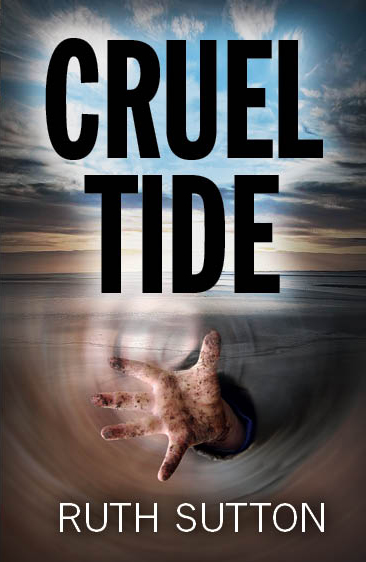
This general anxiety wasn’t helped this afternoon when I took an advance copy of ‘Cruel Tide’ to show to one of my strongest local supporters in her shop where she’s sold heaps of my books over the past few years. ‘Do you want to see it?’ I asked, preparing to pull my advanced copy of the book out of the envelope for the big reveal. She grimaced. ‘I’ve seen the poster, but I can’t look at it because I can’t bear hands.’ For a moment my heart sank. ‘I’ll sell it,’ she added, ‘and I’m sure the cover won’t bother anyone else, but I won’t be able to have it on the counter.’ What??? That’s a strong reaction: I know the cover image is striking, but it was meant to spark curiosity not revulsion. Surely someone would have advised against using the cover if it was that bad?
Front and back covers, with the offending hand.
Anyway, it’s too late now. The books are printed and the full shipment will arrive on Monday. I’m taking a copy through to Waterstones in Barrow on Tuesday and will see what a professional bookseller thinks. I hope she doesn’t have a hand phobia. There must be a special word for that condition, and I hope that it’s extremely rare.
Beyond that the dates and events for presenting the book multiply, in libraries and bookshops all around the area. I’m grateful for all of them, and will enjoy them all too, but I wish I could break out into the wide sales uplands of Manchester or London. What would that take? Maybe I should just rock up to the huge Waterstones on Manchester’s Deansgate, book in hand, and tell them how lucky they are. That’s what I need – more chutzpah.
by admin | Oct 24, 2015 | Cruel Tide, self-publishing
At last! I’ve worked out how to add an image to my blog – the front cover of the new book. I think it’s an arresting image, and pertinent too. See what you think.. It’ll be available from around the end of November 2015, from any good bookshop, from Amazon as a paperback or Kindle ebook, or from me direct via ruthsutton.co.uk. If you’re in Cumbria, your local bookshop should have copies. If you’re in Canada, go through Portage and Main Books in Winnipeg. If you’re in New Zealand, order through Unity Books in Wellington.
The ISBN is 978-0-9929314-0-7


Recent Comments