by admin | May 12, 2017 | crime fiction, crowd-funding, Cumbria, fact-based fiction, genre, Lake District, landscape, Publishing, readers, selling, Uncategorized, West Cumbria
A fter a flurry of activity the Unbound project to publish my next book went live on Monday. I’ve been busy the past few days emailing the link to dozens of people asking for their support. This is the very classy flyer that gives the basic details but there’s much more on this link.
Yesterday I did a marathon tour of some of the libraries at the other end of Cumbria, where foot and mouth was rampant, and heard more memorable stories from the catastrophic outbreak in 2001. It was the smell that is most vividly remembered: animal carcasses, and the smoke from the pyres. A dystopian landscape.
For the next few weeks I’ll be busy getting the link and the flyer shared as widely as possible, and encouraging people to pledge their support for the project anyway they can. If you can help, please do and I’ll be very grateful. Thanks.
by admin | May 7, 2017 | crowd-funding, Cumbria, fact-based fiction, Publishing, readers, Uncategorized, West Cumbria
W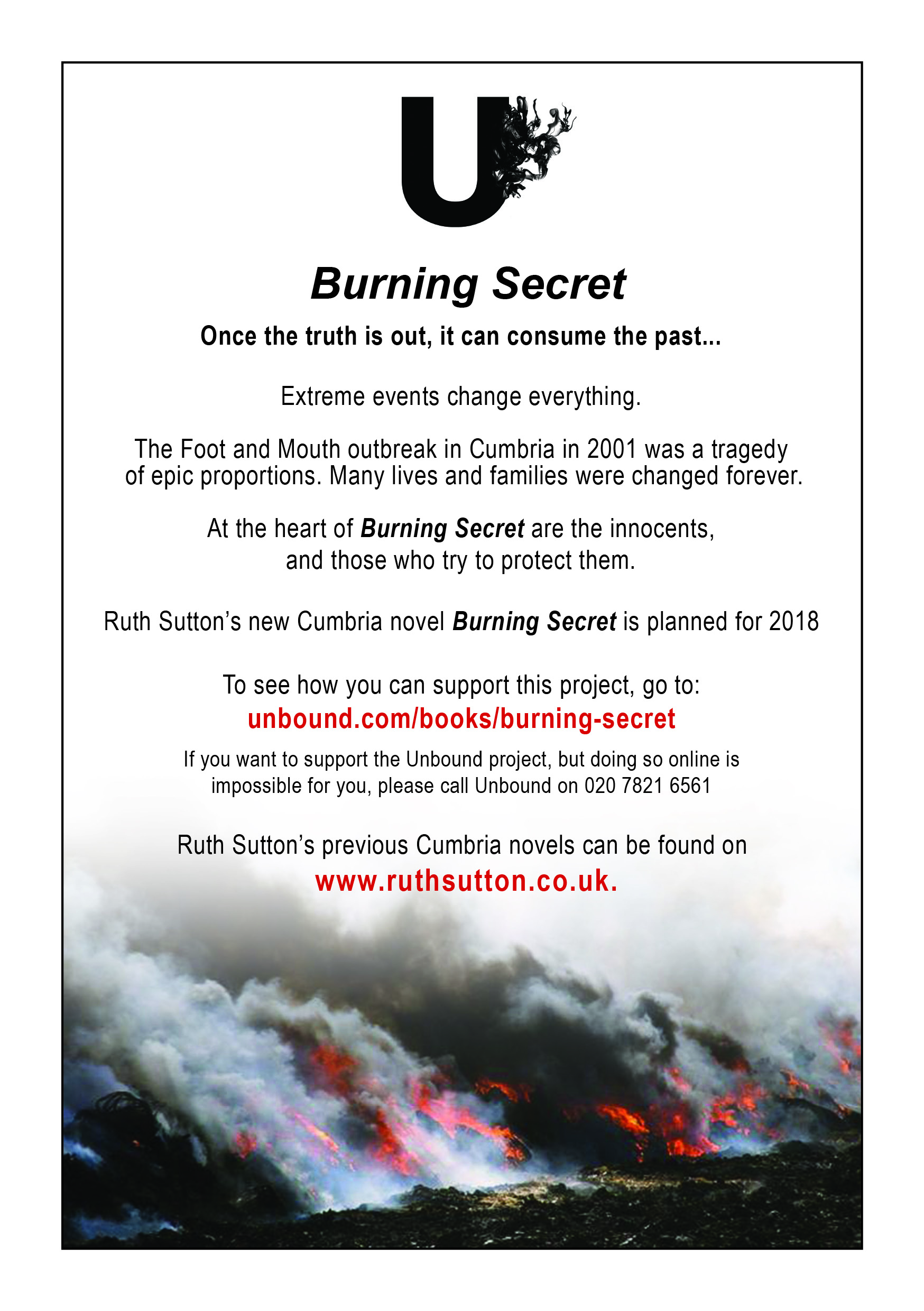 ith only one or two tweaks yet to make, my Unbound project ‘Burning Secret’ should go live tomorrow, Monday May 8th 2017. Then the fun begins, and readers will hopefully begin to pledge their support. There are some good ideas among the pledges, by the way, and definitely worth a look. The link given in the ‘flyer’ to the left isn’t live yet, but if you want to get a sniff of how it will work, go to Unbound and check out some other projects. And keep an eye on FB and Twitter where I’ll let you know the link to go to as soon as it’s ready. I’m finding the whole business exciting, and moderately scary too. It kept me awake for too long last night.
Part of my commitment to the Unbound project is to update my ‘supporters’ regularly about how the project is going, including my actual writing of ‘Burning Secret’. I’ll carry on with this blog of course, and just link across to the Unbound website and vice-versa. Unbound are understandably unwilling to commit right now to a publication date for the the new book, but my target is to have it out by July 2018, and the paperback to follow by Christmas. To achieve that I have to have the first draft finished by November this year, and I’m pretty sure I can do that. With five novels behind me, I’m more experienced and confident, and less prone to paralysing self-doubt. The real task facing me now is not to finish the book by the target date but to do as good a job as the subject matter demands. It needs to be good, really good, to do justice to the horror of what Cumbria went through.
by admin | Apr 30, 2017 | competitions, creativity, Cumbria, Publishing, readers, self-publishing, Uncategorized, West Cumbria
How did this happen, and now that it has, am I up to it?
I started to write relatively late in life: going on a course on ‘How to Write a Novel’ was my 60th birthday present to myself. Four years later I published my first novel ‘A Good Liar’ and four more have followed since then, one each year since 2012. I tried half-heartedly to find an agent or an independent publisher, failed and gave up. Being self-employed for 25 years provided a degree of self-reliance that was useful in the decision to self-publish, and to do so I well as I could, investing my own hard-earned savings where necessary. I did, and it worked, My books have sold thousands of copies, but most of the sales have been within fifty miles of where I live. They’re all set in Cumbria, and this is obviously very attractive both to locals and visitors, but the stories themselves transcend the setting: it’s the people who matter, what they do, how they feel, how they relate to each other and the lives they lead.
Knowing that the stories are wider than the setting, the promotion and distribution problems that all self-published writers face have been frustrating. With few exceptions, the prejudice against self-published books has been obvious: no reviews, no access to mainstream competitions, insufficient ‘celebrity/literary profile’ for acceptance as a speaker at the book festivals, scant regard from buyers for the major booksellers. Fortunately, I enjoy and am good at talking about my work, and do so regularly at libraries, local writers’ groups, and for Women’s Institutes and other organisations. As a result direct sales of my books are a large part of the overall total. The writer in me gets great satisfaction from readers’ appreciation of what I do, but the entrepreneur in me has been frustrated by the book world’s assumption that self-published novels are ‘ipso facto’ second-rate.
In the end, after all my planning, the invitation to move into a wider publishing world came by accident. At the end of one of my library talks a man introduced himself and told me about his daughter who works for a London-based publisher called Unbound. I listened, but people often tell me that they have contacts in the publishing world and almost invariably it comes to nothing. A week later, however, an email arrived from the daughter, a Commissioning Editor with Unbound, who’d been regaled by her parents about my books – which they love – and my talk. We met, we talked, we negotiated, and less than two months later the deal is done: I will publish my next book in 2018 through ‘Unbound’. With a working title of ‘Burning Secret’, it will be a family/police/crime story set in Cumbria in 2001 at the height of the Foot and Mouth outbreak. Next time I’ll explain in detail the stages of writing and publication over the next year or two. For the time being, check on Unbound, and look at ‘How it Works’. In a couple of weeks my project will go live on the Unbound website, video, pitch, pledges, the works. I’ll post regularly about the process here and through the Unbound website. If you want to share the journey, I’d be delighted.
by admin | Apr 7, 2017 | author platform, community, Publishing, readers, royalties, self-publishing, Uncategorized
Last year I heard about Unbound publishing for the first time. At first it sounded like a scam, reminding me of when someone I know went to work for an i nsurance company and pestered all her friends relentlessly to buy a policy so she got the commission. Crowd-funding a book? I couldn’t understand why someone would pay money for an unfinished product and get nothing in return.
Recently, I’ve learned more about Unbound, and the picture is getting clearer. Firstly, Unbound have to be convinced about the quality of an author’s writing: it’s not in their interests to be promoting and publishing poor books. Secondly, people don’t just send money, they ‘pledge’ an amount of their choosing, depending on the ‘level’ of return they want. They can pledge for an ebook, or a special edition hard back, possibly with their name in it as a ‘subscriber’, or even an invitation to the launch party It’s the way commercial publishing was managed in its infancy, more like a ‘pre-order’ process with bells and whistles. If the necessary level of funding isn’t reached, subscribers can ask for their money to be returned, or transferred to another ‘project’. While the writing is in process the author will keep subscribers in touch with how they’re going, probably through a blog like this one – ‘writing about writing’.
So much for the subscribers’ reward, what does the author get out of it? For a start, they get 50% royalties, which is a vastly better deal than the norm, and could be seen as payment for the effort the author undoubtedly will put into the raising of the initial money. They get more of a partnership with the publishers, and a really well-produced edition of their work which their readers will look forward and value. They also get – as far as I understand – a ‘trade’ edition of the book, published in paperback some months after the hardback, and distributed through Penguin Random House. Yes, Penguin Random House – doesn’t get much bigger than that.
There’s the upside. What’s the downside? Well, if you want to go down this road as an author you’ve got to be happy to promote the funding campaign by any and all means short of pestering and alienating your friends. You do the video explaining your writing life and your hopes for the new book, you talk to people directly and through social media, you invite people to feel part of the project you are undertaking. If this sounds tacky, or scary, or beneath your dignity, then don’t sign up for crowd-funding.
You may have gathered that I’m interested in Unbound. If I get the chance to work with them, I’ll take it. It’s not for everyone, but it sounds like something I would enjoy. It would also give me the chance to reach a much wider readership than I have been able to reach so far, without sacrificing my hard-won self-publishing independence. I would relish the sense of involvement and partnership and appreciate the help with the technical aspects of book production. Wouldn’t you?
by admin | Mar 20, 2017 | A Good Liar, abridging, audiobook, costs, promotion, Publishing, readers, self-publishing, trilogy, Uncategorized
I’ve been reading a piece in this quarter’s ‘The Author‘ from the splendid Society of Authors, about the frustrations of listening to a reader making a poor job of recording your book, and being powerless to intervene. And an other piece from Alice Jolly about the merits of the partnership arrangement with a ‘crowd-funding’ publisher, as exemplified in her experience of ‘Unbound’. Both are mainly about the relationship between the author, the book and the publisher.
One of the benefits of self-publishing is that the author is never pushed away from important decisions about her book and expected to leave to others the question of cover, design, print run, other formats, promotion – all the things that so radically affect the link between writer and reader.
Very early on I considered who should abridge and read my books for the audiobook version. There were cost implications of course: doing it myself would save a lot of money. But the decision to trust myself wasn’t just about money. Abridging is tricky and requires a feel for the overall story, and who knows these books as well as the person who wrote them? Successful reading too necessitates a feel for the text and the context, accents, nuances of the characters and the plot, and here again the author – if she knows her setting as well as she should – is best placed to do justice to the words. If you have a teaching background, as I do, you’ve spent many years using your voice to engage an audience, and the skills don’t fade, even if you’re talking only to the microphone.
So I found a local recording studio and am doing everything necessary to prepare and read my own books. It’s hard and time-consuming, but I’m learning a great deal about the flow of the text from reading it out loud. And it’s restoring my faith in my own capacity to tell a good tale, after the thankless task of trying yet again to interest an agent. Have a look at an earlier post to hear my agonising about that.I’m asking again – do I need an agent?
If you can afford it, and if like me you have the power to make your own decisions, consider doing your own audiobook. Very instructive!
by admin | Jan 22, 2017 | A Good Liar, audiobook, editing, readers, self-publishing, Uncategorized, word count
It’s amazing what a relief it is to have decided already that I won’t have a new book out until mid-2018. For the first time in five years I feel I can step back a little and not be plunged immediately into the research and planning of a new book, while simultaneously up to my ears in promotion of the last one. This time I can do the usual round of WI meetings and library groups and still let my mind roam freely around ideas for the next project.
The new book will be a project, of course, but before I get deep into it I’m thinking in greater detail about a new way of presenting at least some of the books on my growing backlist. I’ve done the paperback and the ebook for each book in my original trilogy – Between the Mountains and the Sea – and now I want to do them as audiobooks. It’s been on my mind for a while, but hitherto discounted as too difficult, or too expensive and risky. Now I have the time to break down the audiobook challenge into its component parts and see if I could actually manage it.
The first step came from a casual conversation at our weekly coffee catchup about some very popular local slide shows and where the voiceovers are recorded. A phone call and a few emails later I visited the studio just twenty minutes from my home, to meet the man who owns and runs it. It was a really impressive set-up, and I had the chance to discuss the detailed practicalities of abridging and reading the books myself, to make each one – if possible – fall within the number of minutes on a disc. And would CDs be the best option, given the recent advances in the technology? I have to be careful that in going for the latest technology I don’t put the product beyond the reach of many of my potential audience.
If I take the CD route, each disc has a maximum running time of 80 minutes: how many discs would I need for each book? If it’s more than three, it gets cumbersome and more expensive, but could I abridge sufficiently to manage a running time of 240 minutes without sacrificing the integrity of the story?  I’ve already tried abridging the first book ‘A Good Liar’ and the first cut is relatively easy: there are some sentences and even the odd paragraph that can be cut with too much damage to the story, but after that it gets really tricky. On the first attempt I managed to cut a fair chunk of the text, mainly descriptive details of setting and some extended dialogue, but would that be enough to achieve the time limit overall? Very hard to judge: the only thing to do is to ‘edit/abridge’ the whole book, check how many and what proportion of the words have been removed relative to the whole word count, do some basic sums and see whether it would fit in the 3 CD target. Abridging is always a wrench, and could be annoying for the reader, but at least if my text is abridged it will be done by the author, who is in the best position to know how it should work.
The next decision I needed to make was about whether I could read it myself, and here again the only answer is to try it and see. So I went into the studio, put on the headphones, took my cue from the man at the console and read for five minutes from the abridged copy of ‘A Good Liar’ that I’d already worked on. I managed the reading – although the wonderful microphone picked the rustle of turning pages – and enjoyed it, and was given the demo disc to take home. There are many more practical hurdles to be considered: costs, time, how many to produce, where and how, packaging, promotion, distribution. It’s all pretty outfacing. It would help for a start that I could find the courage to listen critically to the demo disc, but I haven’t found the courage to do that yet! When I finally take that plunge, I hope I feel I can do this job, because I really want to. If I can sort out all the decisions and embrace the adventure of the audiobooks, it could be so much fun!
Recent Comments