by admin | Aug 1, 2015 | A Good Liar, character, Cumbria, Fallout, Forgiven, memory
An email last week (thanks, Lesley) prompted me to think for the first time about book groups reading my books, either as a whole trilogy or just one of the three. I know that the library service in Cumbria has sets of each of the books for loan for this purpose, and I meet people who have read my books with their group, but I didn’t realise that this sometimes entailed using pre-written questions.
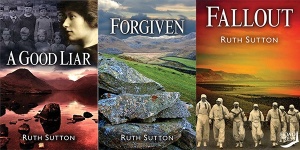
I’ve had a go at creating several questions, in the hope that they might engender some interesting discussion. They seem a bit vague and generic, and I’m sure readers can think of better ones for themselves, but here goes. There are four for each book, and three more that apply to the whole trilogy, which could be adapted for any of the books. Some of the questions for an individual book could be applied for the others too. Mix and match.
I would really love to hear these discussions myself!
A Good Liar
1. How are the characters of Jessie and John introduced to the reader? What do you initially feel about them? Do they develop as the story proceeds, and in what ways?
2. What do you make of Jessie’s affair with Andrew? What does it show about her character, and his?
3. Which passages from the book did you particularly enjoy, or not, and why?
4. This was the author’s first novel: what feedback or advice would you offer her for the future?
Forgiven
1. How is life in a mining community conveyed? Did you find it convincing?
2. Jessie’s independence is threatened in various ways during this story. How does she deal with these developments, and how do you feel about the choices she makes?
3. Do you believe that Maggie genuinely loves John, or is she attracted by what he can offer her?
4. How does the relationship between Jessie and Agnes develop? (This is especially interesting if you’ve witnessed it from the beginning in A Good Liar). What do you think about Agnes’ motives and behaviour?
Fallout
1. How is the character of Lawrence Finer introduced? Do you find him convincing, and what does he add to the story?
2. Do the technical details in this book about the Windscale reactor and the 1957 fire interest you? What could the author have done to improve this aspect of the story?
3. Some of the characters, e.g. Tom Tuohy, were real people working at Windscale in 1957. How does the author weave together fact and fiction. Does it work?
4. The ending of the book, and of the whole trilogy, is left open-ended. Is this satisfying? How would you have liked the book to end?
Between the Mountains and the Sea: the trilogy as a whole
1. Three different communities and decades are explored during the trilogy: what sense did you get of time and place in each of them? Were they convincing and interesting?
2. Does the dialogue contribute to your understanding of the characters? What did you like or dislike about the approach to dialogue?
3. What issues does an author have to consider when writing a trilogy? How has the author dealt with some of these issues?
If you find these questions useful, or have some better ones, let me know. And if you actually use them for a book group discussion, I’d love to know that too, and anything of the feedback or interesting insights that resulted. The next book Cruel Tide, due out in November 2015 is a crime story, and I think the questions might be a bit different.
by admin | Jun 30, 2015 | character, Forgiven, plotting
With novel number 4 all but finished, I find my mind turning on what next. There was an interesting conversation the other day about a possible plot for book 5, and I heard myself saying, ‘Well, I could kill off so-and-so, and have so-and-so falsely accused, etc etc,’ as if my characters are just pawns in my chess game. Which of course they are.
During the very first painful writing experience I recall deciding that one of the main characters should fall seriously ill and might die. I liked this character and had thought a lot about him, his childhood, his anxieties and frustrations, his strengths and talents, and I was proposing to bump him off on a whim, because I wanted to, and more importantly because I could.
As a happily single and self-employed person I must have a need for control over my own life that is perhaps higher than the normal. Creating characters and writing stories about them may be an extension of that inclination to be in charge. Novelists will tell you that their characters have a life of their own, and in their day to day actions that’s true, but ultimately if their creator decides to bump them off, or incapacitate them, they are powerless to resist. The author rules, OK?
By the end of book 2 ‘Forgiven’ I’d decided that one of the characters had outlived her usefulness to the development of the overall story and would have to go. The only question was when and how. In the end I started book 3 with a death, which upset some readers, but ‘tough’. Death is part of life, as are serious illness, unwanted pregnancy, and addictions of various kinds. We need characters who are stable and comfortable and reasonably happy, but they don’t make good stories and usually end up being hapless victims or just a counterpoint to the more interesting complexities of far less likeable people. And I’m the one who gets to decide, who lives, who dies, when, how and to what effect. I need to think about what this says about me.
by admin | May 10, 2015 | character, crime fiction, Explicit details, formula, historical fiction, old posts, plotting, readers, sex scene, structure
As you may remember from previous posts, dear reader, I’ve always struggled with the notion of ‘genre’. I’m not keen on stereotypes generally, and genre has often seemed a rather lazy and delimiting way of categorising a book, to make it easier for booksellers to know which shelf to put it on. As a writer of regional/local women’s commercial historical fiction, my irritation may be understandable. ‘Fiction’ is OK, but the rest of the labels are perjorative, and it’s particularly galling when the ‘local’ label condemns my books to the bottom shelf or the back room alongside books about copper mining in Victorian Cumberland.
After a trilogy in the ‘regional/local women’s commercial historical fiction’ category, I decided to try crime fiction, which I read much of myself and have always enjoyed. As usual, I began by trying to learn about this mode of writing, and enjoyed a day at Crimefest in Bristol last summer, to immerse myself briefly and see what I could pick up. Part of it reminded me of a weekend spent at the Gilbert and Sullivan festival in Buxton the previous year. At both events everyone seemed to know everyone else, except me of course, and there was an air of shared language and complacent jollity, with much kissing and expressions of joy. Even the names at Crimefest had a certain pattern: I was struck by the number of Camilla’s and Jocelyn’s, for example, of whom we see very few in West Cumbria. That must be a cultural habit emanating from London.
The workshop with Matthew Hall and Bill Ryan was really good, as I’ve mentioned before, and focussed mainly on the 3 act structure, that was new to me and quite challenging, which I liked. There was also the interesting idea of a parallel between the external crises in the plot and internal personal crises for the protagonist. I could see how the best of what I’ve read reflected this dual thread. I could also see how the main characters required some personal demons that made them more interesting and vulnerable, and also generated mistakes, false assumptions and some of the blind alleys and red herrings of good crime stories.
The crime fiction shelves,and especially the Nordic noir variety, are full of depressed, lonely, single men with fraught personal relationships and alcohol problems. When does a recurring idea become a cliche? You can change gender, as MR Hall has bravely done, but still end up with the same formula: Hall’s female coroner is depressed, lonely, single etc etc. Or you can give your hero a very particular setting, as with Bill Ryan’s Korolev in Stalinist Russia, and make him a more sympathetic character, but surround his intrinsic goodness with potentially overwhelming conspiracy and evil doings.
There is a general absence of joy among current crime fiction ‘heroes’, which inevitably affects one of the genre cliches, the requirement to include at least one sexual encounter. We are led to believe that sex in fiction increases sales. And sex does appear to be de rigeur these days in crime fiction, which is quite a challenge when many of the current protagonists, however physically attractive they may be, are deeply depressed. They are drawn to the most unlikely and unsuitable people, sometimes against all their better instincts, although the apparently inevitable sexual encounter is often described in unspecific euphemisms. We should be grateful for that at least : anything more graphic might be too grotesque. Incidentally, this feature of the genre was never mentioned in Hall and Ryan’s admirable workshop, but there it is in their books.
So here’s my dilemma as a novice crime writer. Do I absorb the lessons from my more experienced and successful peers and include the obligatory sex scene, even inferentially, or do I eschew it in the interests of the reader’s digestion and stick to the crime stuff – the ‘meat and potatoes’ without the gravy? Much will depend on how I choose to draw my main characters, and I’ve already decided on a rather wild and perverse young woman who finds herself collaborating with a more conventional young man with a less intuitive and more procedural approach. One woman, one man, both relatively young and unattached. The reader’s expectation of sex might be high, but does it have to happen? If a sexual encounter is part of the genre cliche, it would have to be simultaneously provoked by too much alcohol in her case and uncharacteristic lust from him. I could engineer that I suppose by some tricksy plotting, but do I really want to? Is it not possible that two people of different genders can work together without sex? I remember my mother telling me gravely that such a thing was not possible. ‘They’re all the same, dear,’ she said (meaning all men). ‘They only want thing. It’s in their nature.’ I have no clear opinion on this issue.
In each book of my earlier trilogy there was some sex, but I maintain that it was a product of, and necessary to, the development of a character-driven plot. In the current foray into crime fiction, the same must apply. If neither plot nor character would generate a sexual episode naturally, by its own volition, then it won’t happen. Part of me is quite relieved. Trying to write with commitment about something implausible is too difficult. I’m grateful too that as a self-published author I’m under no external pressure to increase sales by giving way to this particular genre cliche. No editorial or marketing voice is whispering in my ear to include something I don’t feel the need for.
This is not to say that in future books, even those with the same characters, sex might not arise plausibly and find a place in the story. But genre cliche alone will not be enough. If we rightly criticise cliche in other aspects of writing, we shouldn’t let the obsession with genre lead to formulaic structures and plots. If that makes them less likely to be best-sellers, so be it. Most of us will never make a full living from writing anyway, so we might as well hang on to our self-respect and avoid cliche in all its forms.
by admin | Apr 7, 2015 | character, old posts, opening paragraph, overview, plotting, readers, structure
I’ve reached the conclusion that time away from ‘the current work’ enables me to step back and view what I’m doing more objectively, and more clearly, but it has to be a certain sort of break to be most effective. Here’s how it seems to work for me. I’ve been writing outlines and planning the current book (number 4) for some months now. I knew I would be taking two months away from it early this year and expected that this would provide the space I needed to reflect on the project – characters, pace, themes, plot and so on – so that everything would be clearer when I returned. But that didn’t work. The time away was like being on a different planet, so exciting, varied, all-consuming, and exhausting at times that there was no space in my head to reflect at all about the book. After I’d got home and recovered for a while I just started the first draft as I’d planned to do, using the outline much as it previously stood.
Ten days later, into the first draft and rolling along quite nicely, I’ve just had another shorter break over the Easter weekend. Immediately beforehand I was up to my ears in writing and editing, working and reworking the original outline as the detail on the ground was revealed – as I mentioned in my previous blog post. Maybe that was why, during four non-writing days, my head has been wrapped around the story to the point where I could hardly sleep. Two darlings have been ruthlessly put to the sword as a result. The first of them, the opening paragraph, was nudged towards its demise by my perceptive editor Charlotte who skims the drafts every now and then and always asks incisive questions. The old first paragraph which I’d polished carefully for months, is now dead, and the one will be sharper, clearer and more likely to capture a reader’s attention.
The second doomed ‘darling’ is a character from my third book, who was about to reappear in this one. I was looking forward to meeting him again, but yesterday, when I was half watching Wolverhampton Wanderers vs Leeds United on the TV, I suddenly thought ‘Why do I need him here? What’s he adding to this story? If he has a function, is that not already being played by another character? Why complicate matters unnecessarily?’ Scales fell from eyes and when the next stage of the outline is re-written, he will be gone.
Have I ever mentioned the Faber Academy course I went on years ago called ‘Stuck in the Middle’? Just a weekend, but I still remember the shot in the arm it gave me. Gill Slovo and Sarah Dunant led it as a double act, a pincer movement of perception and experience that caught many of us round the table in the middle, making us look at our half-finished work from the outside rather than the inside. It was harrowing but salutary. I’ve thought about signing up again, but I don’t think I need to. I think I can be ruthless – no pun intended – all by myself. Maybe watching football helps.
by admin | Jan 12, 2015 | Authenticity, character, crime fiction, genre, readers, villain
The current novel is my first attempt at crime fiction, after reading tons of it over the past decades. Reading other authors’ crime fiction is easy: you can be self-righteously critical of too much information, too little information, too many clues, none at all, plot twists you can see coming a mile off and others so arbitrary you feel cheated. Oh yes, I can take other people’s work to pieces, but writing your own is a different story, literally.
To some extent, crime fiction can feel a bit formulaic. You go on the course and buy the book – the Arvon book on crime writing, for example – and see what protocols characterise the genre. But a perverse refusal to obey rules that I have always struggled with is getting in my way. If someone says, you need a 3 act structure I say ‘Really? Why?’. I’m working hard to overcome this unhelpful trait. So for now, as an novice in the field, I am following the structural conventions, but am still struggling with whether and how to hide clues, and pop in just enough false leads and red herrings (where on earth did that phrase come from?) to keep the reader on her/his toes.
Only got the outline so far, although it’s pretty detailed in parts and up to 18,000 words. The clues etc are in the outline, but because they’re in this truncated form they’re obviously standing out more than they should and hopefully more than they will when the full ms in in place. Those trusted few who are reading and providing feedback on the outline are counselling a lighter touch, and they’re probably right. I’m pleased with one false trail that serves to undermine the protagonist’s self-confidence, which always adds to the tension.
The new book is set in the recent past, and so has necessitated some research about details of the period, but I think I may be learning how to handle it as the obsession for authenticity isn’t looming as large in my mind as it did previously. Some details are essential of course, but I’m also trying to detach the action a little from its setting to avoid local readers feeling that their home turf is being traduced by bad people doing bad things. No-one minds recognising the local setting when the characters and their actions are benign, but I don’t think that will hold true when some of the people are pretty nasty.
The overall problem is how to balance the inferences with the need for twists and a ‘reveal’ towards the end. Classic examples of the genre require the main characters to be summoned finally by the hero detective who then rehearses the clues etc before finally revealing the baddy. I definitely can’t be bothered with that, but some final shocks are necessary. Too many clues may herald and reduce the impact of the shock, but if there are none, is the writer cheating? Maybe I read too fast and without sufficient thought, but sometimes I’m not prepared for the final reveal at all and don’t like that. Thinking about it, what really matters, even in crime fiction, is that we have to care about the characters, even if we don’t like them. What happens to them should matter to us: it’s not just a plot device. And we’re back to character driving the story as much as plot.
What I seem to be doing as the outline expands slowly into a first draft is putting in clues etc and then paring them back to the merest sliver of a passing detail that could be missed or noticed and remembered, so that the assiduous reader feels rewarded later for their concentration. Will it work? Hard to tell. The acid test is giving it to someone to read who’s never read any previous version or had any conversation about the plot. They have to come to it raw, as it were, and then tell me how satisfied or otherwise they feel. It’s going to be a while before I get to that stage.
by admin | Dec 31, 2014 | character, Forgiven, readers, villain
Every now and then I check to see if anyone has posted a review of my books on Amazon. Not that they make any difference to sales – or do they? – but just out of curiosity. The reviews are usually good, I’m pleased to say, but one for ‘Forgiven’ was a 3 star and I checked it. Can’t recall the precise wording but the general gist was that the reader was unimpressed as he/she didn’t find any of the characters ‘sympathetic’. That’s OK: but I asked myself whether I had really tried to make my characters likeable, and what that would mean.
‘Likeability’, like beauty, is very much in the eye – or feelings – of the reader. Who and what we like depends on who are, our own life experiences and our view of the world. It is therefore unlikely that any one character would be liked by everybody who encountered them. In a novel there will be a wide range of characters to choose from, but even then it may be that none of them appeal to a particular reader, as in the case of my 3 star reviewer.
The only book I’ve read recently that presented me with such a panoply of unattractive people was Gillian Flynn’s ‘Gone Girl’, which has been a runaway best-seller, despite my feeling that it relied for its tension on the reader’s detached curiosity about ‘whodunnit’ without actually caring at all, as none of the people involved were worth caring about. I couldn’t even finish it, but I assume I was in a minority. Then I began to wonder whether it matters. Do we need to like the characters for them to carry us through a novel? Can we care about them while still finding them unsympathetic?
The answer of course must be ‘Yes.’ Lear is a monster, Henchard stubborn and self-defeating, Emma vain and self-obsessed. In her own small way my heroine Jessie Whelan is a very difficult woman who creates most of her own crises. As one of my correspondents put it, ‘That Jessie – sometimes I could slap her.’ But without those flaws she could be flat and uninteresting, and her story less rich and worthy of the telling. John, her son, is portrayed as a young man damaged by the restrictions of his early life, awkward, distrustful, self-centred, although he is redeemed later by his love for Maggie and his children. On the other hand, two minor characters who appear in all three books and many of my readers enjoy are Hannah and Fred, who live at Mill Cottage in Boot. They both struggle with disability – the one-eyed woman and the one-legged man – and both rise above it with humour and unselfconscious enjoyment of their lives and each other. I loved writing about them, and mourned for Fred’s sad decline. In planning the current book I’m working hard to create rounded characters with weakness and challenges, not to make them likeable but to make them human. Even the villains can’t be all bad: they too need some redeeming features that drive their behaviour and provide a necessary ambivalence for the reader. Sympathy with the characters is not required, but a flicker of empathy helps to engage the reader, don’t you think?
Recent Comments